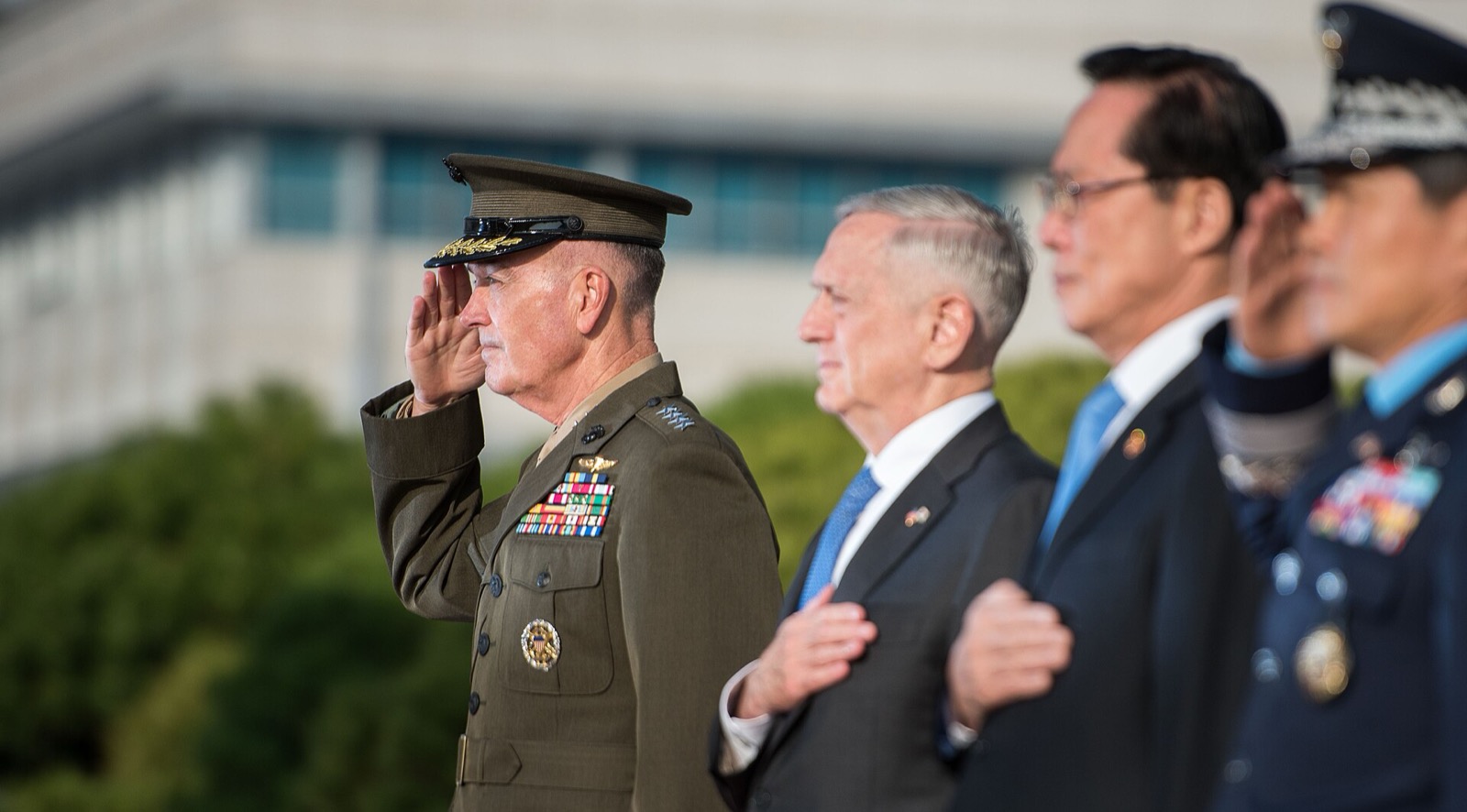
Photo: U.S. Department of Defense (US Army Sgt. Amber I. Smith) · File:49th Security Consultative Meeting 171028-D-SV709-0091 (26208322679).jpg · Public domain
The government wants to set the year for taking over wartime operational control (OPCON) first. OPCON is the authority to command the Combined Forces of South Korea and the United States if war breaks out, and a U.S. four-star general now holds it. According to the Dong-A Ilbo, the government is pursuing a plan to fix the target year at the Security Consultative Meeting (SCM) early next year. The SCM is a meeting the two countries' defense chiefs hold every year. The idea is to set the timing first even if the United States demands new conditions. The remaining conditions would reportedly be met after that. If the year for taking over wartime command of the military is set first, does that depart from the South Korea-U.S. agreement to transfer OPCON after the conditions are met?
A month ago, the order the government described was different. According to the Gyeongbuk Domin Ilbo, Defense Minister Kang Shin-chul told the National Assembly on October 26, "We are consulting closely in the direction of completing Full Operational Capability (FOC) verification and then deciding the transfer year." FOC verification is the second stage of verification. It checks whether the Future Combined Forces Command, which will command the combined forces after the transfer, works properly. According to the same report, the government had planned to wrap up this verification at this year's SCM. That SCM was postponed to early next year.
The South Korea-U.S. joint communiques set out who decides the transfer timing. According to the 2014 joint communique of the 46th SCM, OPCON is transferred when two conditions are met. South Korea and the alliance must have the critical military capabilities, and the security environment on the Korean Peninsula and in the region must be conducive to a stable transition. The same communique said, "The two nations' National Command Authorities will decide on an appropriate date for OPCON transition based on the SCM recommendation." At a briefing the next day, the Ministry of National Defense explained that this recommendation "reflects the degree to which the conditions are met." The 50th SCM communique in 2018 also said the two sides would regularly assess implementation through the annual SCM and other channels to "judge the specific timing of OPCON transition."
The communiques did not say when the target year would be set, however. The government's original plan was also to set the year ahead of the final verification. Linking an official's explanation in May with the minister's remarks in October gives this order: finish FOC verification, set the year, then carry out the third and final stage, Full Mission Capability (FMC) verification. According to the Digital Times, a Ministry of National Defense official said on May 20, "Once 'Year X' (the target year for OPCON transition) is decided, FMC will begin right away."
There was also a time when a target year existed alongside the conditions-based transfer. At that 2014 briefing, the Ministry of National Defense said it would pursue the transfer "aiming for the mid-2020s," when the critical military capabilities would be in place. At the same briefing, the ministry added that the target was a "planned schedule" and that weapons development could be delayed. Twelve years later, OPCON still has not been transferred.
What changed in this plan is the order of FOC verification and the decision on the year. In the government's explanations in May and October, FOC verification came before the decision on the year. In the plan the Dong-A Ilbo reported, the year comes first even if the United States puts forward new conditions. FOC verification is something the two sides agreed last year, in the 57th SCM communique, to pursue this year. The Ministry of National Defense's October 28 press release listed the schedule for the next talks, not verification results.
On the U.S. side, by contrast, people keep saying conditions come first. According to the Kyunghyang Shinmun, Gen. Xavier Brunson, commander of U.S. Forces Korea, said on October 14 (local time) that "conditions have changed," citing the advance of North Korea's nuclear and missile programs. According to the Dong-A Ilbo, former Deputy Secretary of State Stephen Biegun said on November 20, "The idea of making a major decision based on a timeline rather than a judgment based on capabilities defies all logic."
Minister Kang believes the conditions are already in place. According to the Maeil Shinmun, Kang told the National Assembly's Special Committee on Budget and Accounts on November 12 that he judges all three conditions to have been met, and said, "The transfer is possible even right now." If Kang's judgment is right, setting the year first does not skip the conditions. But this judgment is the South Korean government's assessment. Last year's joint communique said there had been "meaningful progress" in assessing the conditions.
U.S. law also takes the agreed plan as its standard. The U.S. National Defense Authorization Act for Fiscal Year 2026 has a provision on the OPCON transfer. Under it, funds under the act may not be used to complete a transfer that departs from the plan agreed by South Korea and the United States. The restriction lifts 60 days after the U.S. secretary of defense submits a certification and an assessment to Congress. The certification states a judgment that such a transfer is in the U.S. national security interest. What this provision blocks is not setting a year but a transfer that departs from the agreed plan.
The government has two questions to answer. Is the year to be set at the SCM early next year a target that changes if the conditions are delayed, or the transfer date the two presidents will decide? Will the FOC verification planned for this year be finished before that SCM?
Next on the calendar are the defense ministers' talks in Washington in December and the SCM early next year. Setting a target year first does not conflict with the wording of the joint communiques. But locking that year in as a transfer date without a conditions assessment and an SCM recommendation would skip the order set out in the 2014 and 2018 communiques.
Sources
- Dong-A Ilbo, Government push to fix the OPCON transfer timing first and opposition from a former U.S. official, November 23, 2026. The government plan is reported through this article (no government document).
- Gyeongbuk Domin Ilbo, Minister Kang Shin-chul's remarks at the National Defense Committee's comprehensive audit on October 26, October 26, 2026.
- Ministry of National Defense, Joint communique of the 46th Security Consultative Meeting, paragraph 11, October 23, 2014.
- Ministry of National Defense regular briefing (Korea Policy Briefing), Explanation of conditions-based OPCON transition, October 24, 2014.
- Ministry of National Defense, Joint communique of the 50th Security Consultative Meeting, paragraph 9, October 31, 2018.
- Digital Times, Ministry of National Defense official's explanation on May 20 (Year X and FMC), May 2026.
- Ministry of National Defense (reposted on Korea Policy Briefing), Joint communique of the 57th Security Consultative Meeting, paragraph 5, released November 14, 2025.
- Ministry of National Defense press release (reposted on Korea Policy Briefing), South Korea-U.S. defense ministers' talks on the sidelines of the ADMM-Plus, October 28, 2026.
- Kyunghyang Shinmun, SCM postponed to early next year and remarks by Gen. Brunson, October 28, 2026.
- Maeil Shinmun, Minister Kang Shin-chul's November 12 remarks at the budget committee and a response from former commander Brooks, November 14, 2026.
- U.S. National Defense Authorization Act for Fiscal Year 2026 (Public Law 119-60), Section 1268(a)-(c), enacted December 18, 2025.
Translated from the Korean original published on November 23, 2026.
Korean original: 10월엔 검증 뒤 연도 결정이라더니…전작권 전환 연도부터 정하겠다는 정부