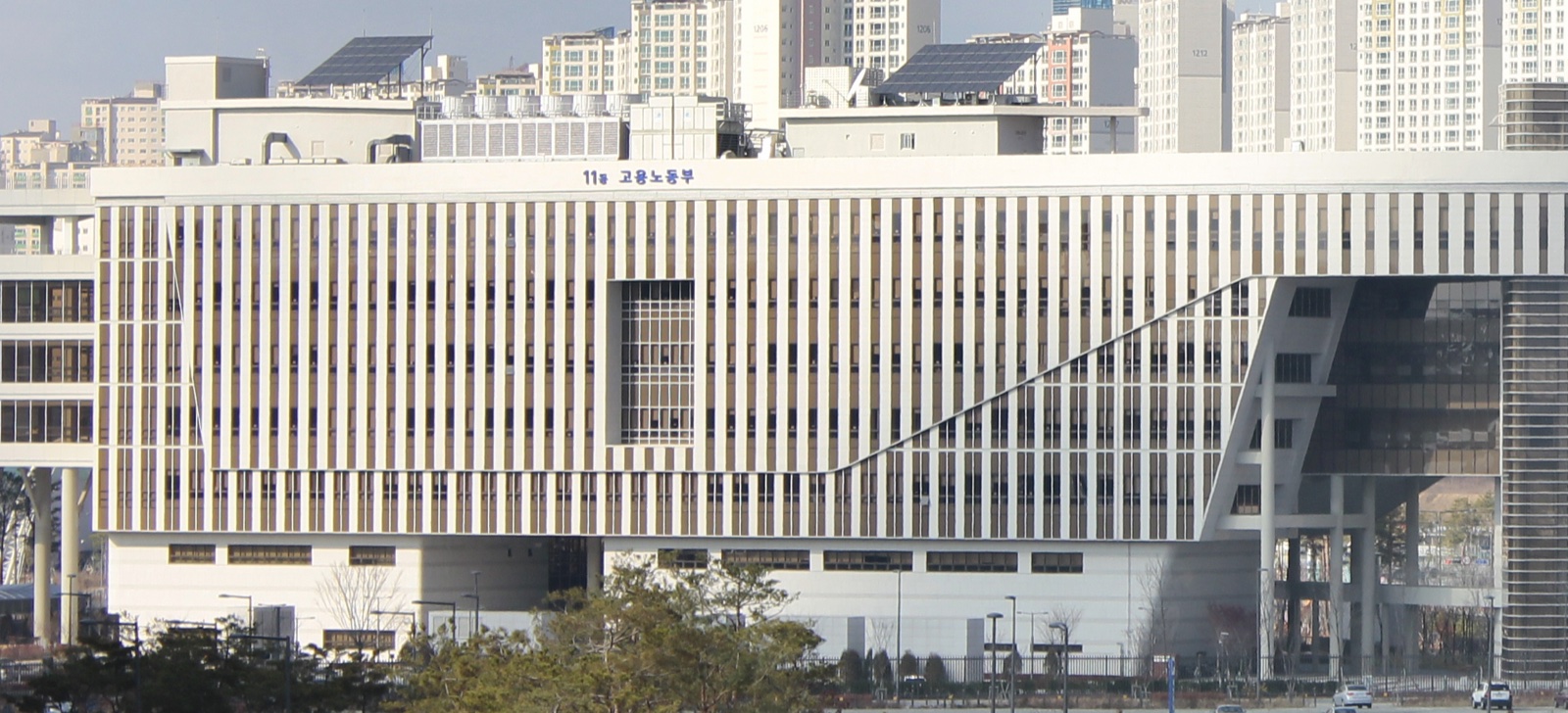
Photo: Minseong Kim · File:Ministry of Employment & Labor(South Korea).jpg · CC BY-SA 4.0
The Ministry of Data and Statistics, the upgraded successor to Statistics Korea, said on November 24 that wage jobs had increased by more than 400,000 in a year. But of the 406,000 added jobs, 277,000 were held by people 60 and older, while jobs held by people in their 20s and younger actually fell. At what kinds of workplaces were the new jobs created, and how many of them did government money create?
According to the wage employment trends for the second quarter, jobs as of May rose by 406,000 (1.9%) from a year earlier. The increase a year earlier was 111,000, and in the first quarter of this year it was 292,000. The size of the increase grew for four quarters in a row.
These statistics count jobs, not employed people. Only jobs recorded in social insurance or daily wage income reports are included, and a person who works at two places is counted as two jobs. Jobs are classified by the age of the person working in them. A person who turned 60 during the year can be counted in a job for people 60 and older even while working in the same job.
By age, jobs held by people 60 and older rose by 277,000, accounting for 68% of the total increase (NEXT calculation). They rose 6.9% in a year, also the highest growth rate of any age group. Jobs held by people in their 30s rose by 123,000, and by people in their 50s by 59,000. Jobs held by people in their 40s rose by only 4,000.
The older population grew just as quickly. In the employment trends for the same month of May, the population aged 60 and older was up 492,000 from a year earlier. The number of employed people aged 60 and older rose by 171,000, but the employment rate for people 60 and older fell by 0.4 percentage points.
Of the increase in jobs held by people 60 and older, 45% came from one industry, health and social welfare (NEXT calculation). In this industry, jobs held by people 60 and older rose by 126,000. Health and social welfare as a whole added 161,000 jobs, the most of any industry. Of these, 122,000 were in social welfare services. This category includes nursing homes for older people and day care centers. Health and social welfare jobs also rose by 134,000 in the same quarter a year earlier.
Jobs held by people in their 20s and younger fell by 56,000 from a year earlier. They fell by 28,000 in manufacturing and by 15,000 in information and communications, and rose by 32,000 in accommodation and food services. The overall decline in jobs for people in their 20s and younger narrowed from 135,000 a year earlier and 76,000 in the first quarter of this year. In the employment trends, the population aged 15 to 29 fell by 152,000 in a year.
Care jobs also include government programs. The Ministry of Health and Welfare said in February that it would provide 1,152,000 senior jobs this year. That is 54,000 more than last year. Senior capability jobs, which use the experience and skills of older people, rose by 37,000 to 197,000. According to the health ministry, these jobs are placed mainly in fields with high demand from vulnerable groups, such as care, safety and the environment.
But these statistics cannot show how many of the added health and social welfare jobs were funded by the government. The tables in the press release are broken down by industry, age, sex and type of organization. There is no table showing whether a job receives government financial support. Participants in senior job programs are also included in these statistics only if they are recorded in social insurance or daily wage income reports.
The two statistics also point in different directions in one respect. In the employment trends, which survey sample households, the number of employed people in May fell by 40,000 from a year earlier. Jobs counted from reported data for the same month rose by 406,000. The Ministry of Data and Statistics noted that the two statistics differ in what they cover and how broadly, and advised care when using them.
Of the 161,000 jobs added in health and social welfare, how many were funded by the government, like senior job programs? Without those jobs, how much did jobs increase in a year?
Of the 406,000 added jobs, 277,000 were held by people 60 and older, and 45% of those came from health and social welfare. How many of them the government's budget created has not yet been put in numbers.
Sources and scope of verification
- Ministry of Data and Statistics, press release on wage employment trends for the second quarter of 2026 (as of May) (attached PDF pp. 3-4 summary, p. 5 overall trends, p. 6 table by major industry, p. 15 table by age group, p. 18 table by age group and major industry, appendix on methodology), November 24, 2026. The 68% is the 277,000 increase for people 60 and older divided by the total increase of 406,000; the 45% is the 126,000 increase in health and social welfare for people 60 and older divided by the 277,000 increase for people 60 and older (NEXT calculation).
- Ministry of Data and Statistics, May 2026 employment trends (press release and statistical tables posted by the KDI Economic Information and Education Center, tables of changes for ages 60 and older and 15 to 29), June 11, 2026.
- Korea.kr policy briefing, 1,152,000 senior jobs to be provided this year (Ministry of Health and Welfare announcement), February 2, 2026.
Translated from the Korean original published on November 24, 2026.
Korean original: 늘어난 일자리 10개 중 7개 가까이 60대 이상…20대 이하는 줄어