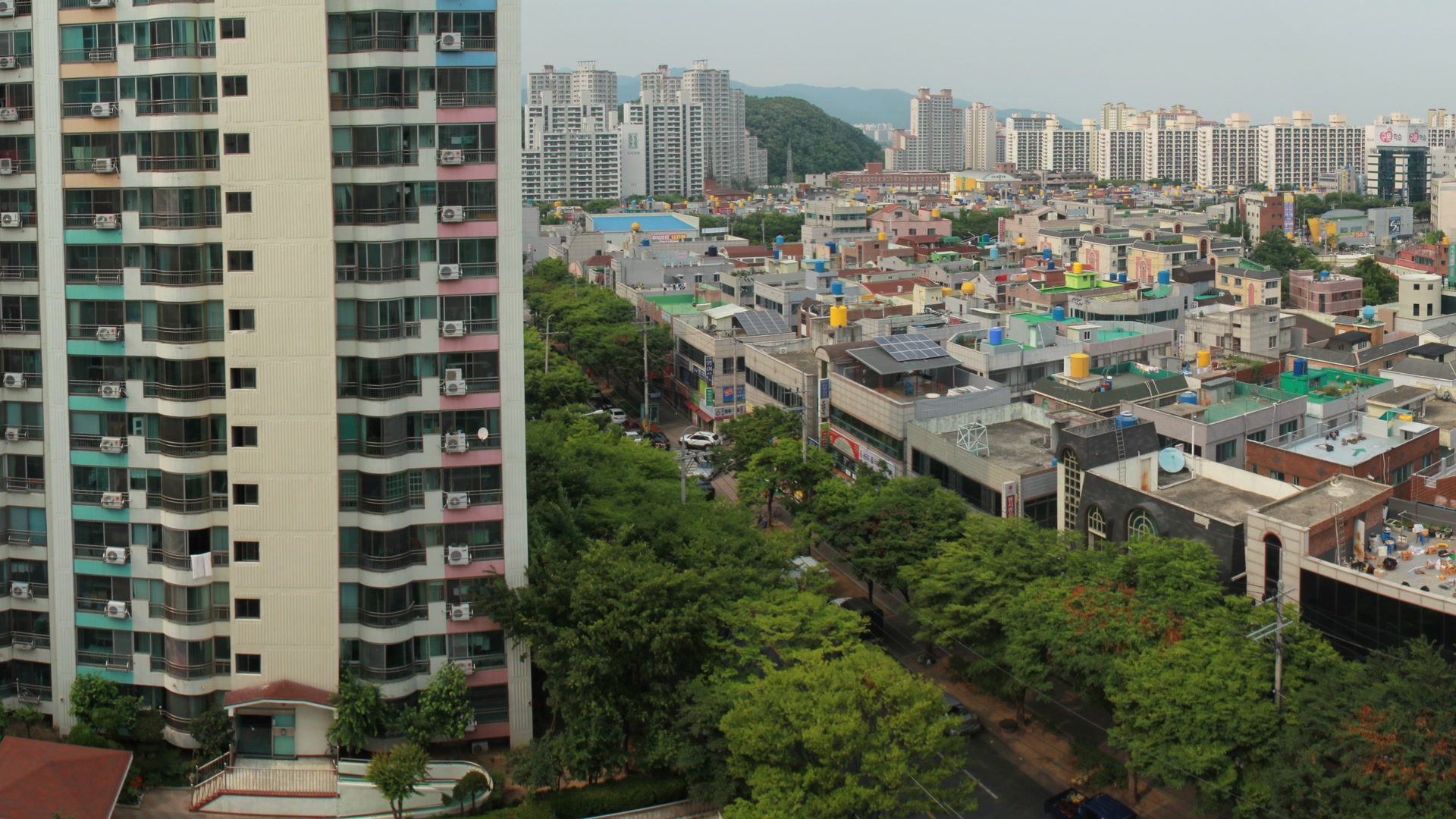
Photo: Er-Jin Jang · File:Daegu Apartments Panorama.jpg · CC BY-SA 3.0
An estimated 561,000 homes have gone unoccupied for more than a year. That is the sample result of the 2025 Population and Housing Census, released on November 24 by the Ministry of Data and Statistics, the upgraded successor to Statistics Korea. The government's national count of vacant homes, as of 2024, is 134,000. The Ministry of Land, Infrastructure and Transport has said abandoned empty buildings could cause regional decline and speed up the disappearance of rural communities. Both numbers use one year as the standard. Why are they more than four times apart?
The census counts every home that nobody lives in on the survey date as a vacant home. In the 2025 Population and Housing Census sample results, the ministry calls these "unoccupied homes." Every home with no residents on November 1, 2025, is included. Counted this way, there were 1,722,000 vacant homes. Of these, 32.6%, or 561,000, had been empty for more than a year. This figure is an estimate, however, made by surveying a sample of 20% of census enumeration districts nationwide and projecting it to the whole country.
Vacant homes as defined by law cover a narrower range. Under the Act on Special Cases Concerning Unoccupied House or Small-Scale Housing Improvement, a vacant home is a home that no one has lived in or used for one year or more. That year is counted from the date the mayor, county head or district head confirms whether anyone lives there. The land ministry's plan also described current vacant homes as "homes not lived in or used for one year or more." The enforcement decree of the same act excludes public rental housing, unsold homes less than five years after approval for use, and homes kept for short stays, such as second homes, among others.
The census also includes homes the law excludes. Homes vacant because they are "used occasionally" numbered 486,000, and homes that were "unsold or not yet moved into" numbered 261,000. Both are figures out of all 1,722,000 vacant homes. The ministry's tables count the length of vacancy and the reason for vacancy separately. So these tables cannot show how many of the 561,000 homes empty for more than a year are second homes or unsold units.
Still, some numbers can be looked at separately. Detached houses empty for more than a year numbered 256,000, close to twice the government's entire count. Of vacant detached houses, 60.5% had been empty for more than a year, compared with 21.3% of vacant apartments. By province, 45.8% of vacant homes in South Jeolla had been empty for more than a year, compared with 21.8% in Seoul (NEXT calculation).
Homes left empty for a long time and damaged homes increased over five years. Homes empty for more than a year rose by 174,000 from 387,000 in 2020 (NEXT calculation). Their share of vacant homes also rose from 25.6% to 32.6%. Homes the ministry classified as "more than half damaged" numbered 76,000, or 4.4% of vacant homes. In 2020 this share was 1.6%, and 73,000 of the 76,000 this time were detached houses.
Rural vacant homes are counted separately by the Ministry of Agriculture, Food and Rural Affairs. The ministry submitted its figures to the office of Rep. Yun Jun-byeong of the Democratic Party of Korea. According to a Segye Ilbo report, rural vacant homes rose from 65,019 in 2023 to 84,200 in 2025. Over the same period, about 7,700 to 7,900 cases were dealt with each year. Of the 7,935 cases dealt with in 2025, 92.2%, or 7,315, were demolitions. Homes repaired for use numbered 620, or 1.1% of the 56,061 rural vacant homes judged repairable.
The government plans to change how it counts vacant homes. According to the plan to promote the improvement of vacant buildings released by the land ministry in October 2025, an annual status survey will be added to the fact-finding survey held every five years. A new "special act on the improvement of vacant buildings" will also cover buildings whose construction has stopped, in addition to vacant homes, and a national fact-finding survey will be held right after it takes effect. Separately, the Special Act on the Improvement and Management of Vacant Houses in Agricultural and Fishing Villages was enacted in June 2026 and takes effect on June 17, 2027.
The gap between the two numbers is not the number of abandoned homes the government missed. The census figure is a sample estimate, and the reference years differ: 2024 for the government count and 2025 for the census. The ministry also noted that the sample results may differ from the full count compiled from administrative data (the register-based census).
How many of the 256,000 detached houses empty for more than a year have cities, counties and districts confirmed as vacant homes? Once the unsold units and second homes that the law excludes are taken out, how much of the gap between the two numbers remains?
The government's count of 134,000 is less than a quarter of the homes the census estimates have been empty for more than a year (NEXT calculation). The statistics published now cannot show how many abandoned homes are in that gap.
Sources and scope of verification
- Ministry of Data and Statistics, press release on the 2025 Population and Housing Census results (sample survey) (explanatory notes, housing sections 1-3, attached statistical tables 27-29), November 24, 2026. The 174,000 is 561,000 in 2025 minus 387,000 in 2020; a quarter is 134,000 divided by 561,000 (23.9%); the South Jeolla and Seoul shares are the 12-months-or-more figures by province in table 28 divided by unoccupied homes (NEXT calculation).
- Statistics Korea, briefing on the 2020 Population and Housing Census (sample) results (387,000 homes vacant for 12 months or more in 2020), December 24, 2021.
- Korean Law Information Center, Act on Special Cases Concerning Unoccupied House or Small-Scale Housing Improvement, Article 2(1)1 (definition of vacant home).
- Korean Law Information Center, Enforcement Decree of the Act on Special Cases Concerning Unoccupied House or Small-Scale Housing Improvement, Article 2 (homes excluded from vacant homes).
- Korea.kr policy briefing, Ministry of Land, Infrastructure and Transport plan to promote the improvement of vacant buildings (134,000 vacant homes as of 2024, annual status survey), October 2, 2025.
- Segye Ilbo, rural vacant home figures and improvement results for 2023-2025 submitted by the Ministry of Agriculture, Food and Rural Affairs (office of Rep. Yun Jun-byeong), October 7, 2026.
- Korean Law Information Center, Special Act on the Improvement and Management of Vacant Houses in Agricultural and Fishing Villages (Act No. 21796, enacted June 16, 2026, effective June 17, 2027).
Translated from the Korean original published on November 24, 2026.
Korean original: 1년 넘게 빈 집 56만 호 추정…정부 빈집 집계는 13만 호