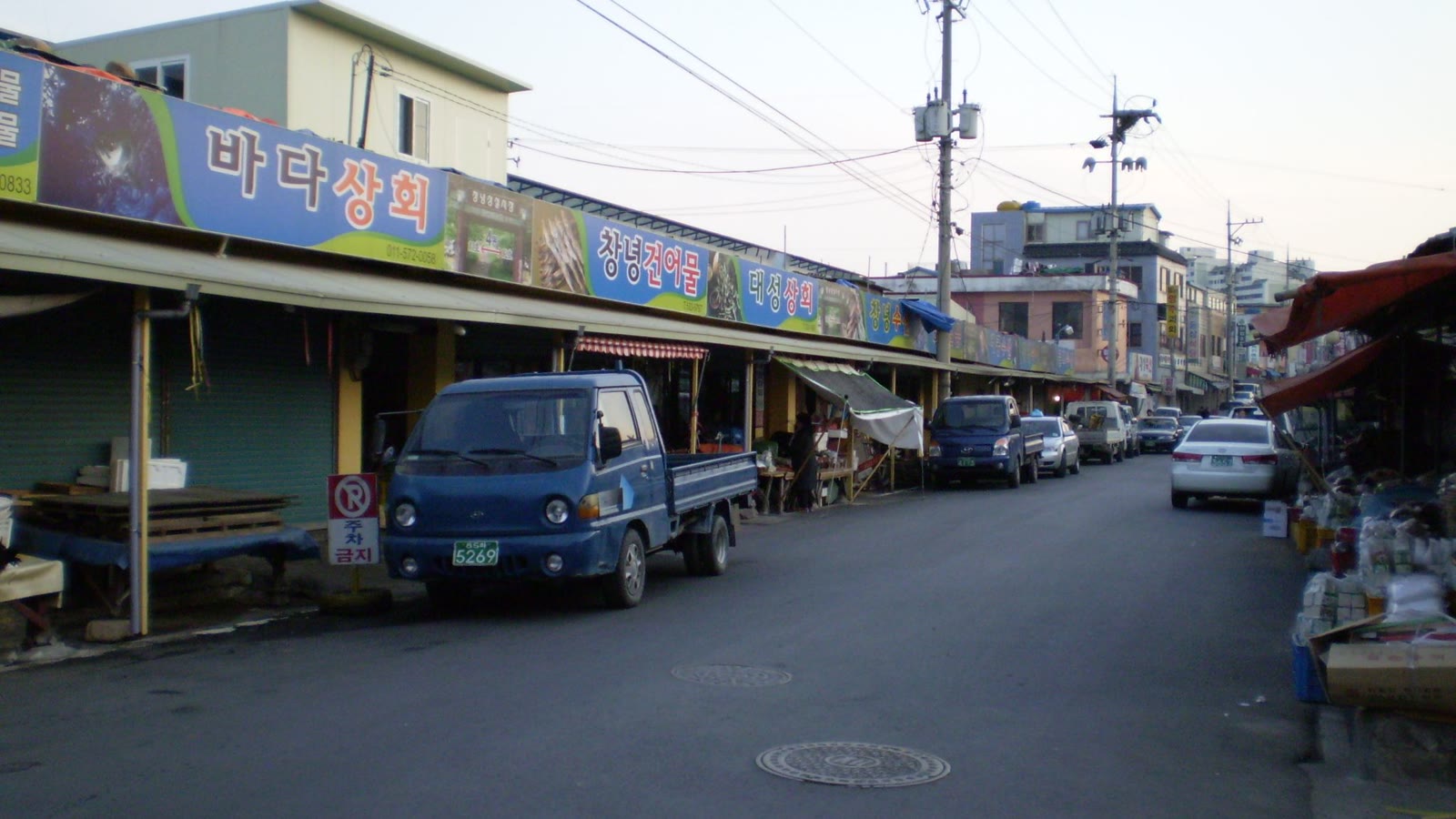
Photo: Visviva · File:Changnyeong market outside.jpg · 퍼블릭 도메인
The Ministry of the Interior and Safety began a winter campaign for storm, flood and earthquake insurance on November 22. It is a policy insurance that covers damage to homes and shops from natural disasters such as typhoons, heavy rain, heavy snow and earthquakes. According to Dailian, the ministry said the government supports 55% and up to 100% of the total premium. One merchant whose shop was flooded by heavy rain in August paid 155,800 won of their own premium and received about 73.92 million won in insurance money. Yet fewer than 5 of every 100 small business shops have this insurance. The government pays more than half the premium, so why don't merchants sign up?
At the end of May this year, the enrollment rate for small business shops and factories was 4.6%. The figure comes from a ministry press release issued on June 29. The rate for homes at the same time was 34.9%. By the count reported by the Kyunghyang Shinmun, only 39,173 of 850,348 eligible sites were insured.
The support rate that applies to shop owners is 55%. That is the standard rate for shops and factories listed in the ministry's product guide. Full 100% support applies only to the homes of low-income people, such as basic livelihood security recipients, who live in disaster-prone areas. Some local governments add their own support, but that share varies by region.
Support for small businesses has actually gone down recently. The Seoul Economic Daily reported ministry data obtained by the office of Lim Ho-seon, a Democratic Party of Korea lawmaker. The support rate for ordinary small businesses fell from 70% in 2022 and 2023 to 55% in 2024. As a result, the merchant's share rose from 30% to 45% of the premium.
The enrollment rate also dropped over the same period. The figures appear in the proposal statement of a bill filed in July by Democratic Party of Korea lawmaker Bok Gi-wang and others. The enrollment rate for small businesses and similar groups fell from 23.1% in 2023 to 5.3% in July 2025. After that came 4.6% at the end of May this year.
Still, the support rate alone does not fully explain this change. Donated enrollment, in which companies and others pay the merchant's share of the premium, also fell. According to the ministry data reported by the Seoul Economic Daily, donated enrollments went from 107,563 in 2023 to 10,741 in 2025. 2023, when the enrollment rate was around 23%, was the year donated enrollments topped 100,000. On the other hand, ministry figures reported by News Tomato put the enrollment rate at 6.7% in June 2022. That was when combined national and local support was 70% or more.
A merchant who rents a shop can insure only facilities, fixtures and inventory, not the building. The ministry says that "not only owners but also tenants can sign up." But the law defines the person who receives compensation as the owner of the insured property.
So the compensation a tenant can receive easily falls short of the damage. According to the Kyunghyang Shinmun, compensation is currently capped at 50 million won each for buildings, facilities and fixtures, and inventory. The combined limit for a shop is 150 million won, or 100 million won without the building. The Kyunghyang Shinmun reported the case of a medical device store in Hampyeong, South Jeolla Province. The flood damage confirmed by the county was about 160 million won. The insurance payout came to about 50 million won only after the owner hired a separate loss adjuster. A loss adjuster is a specialist who works out how much an insurance claim should pay. The store owner said, "The level of compensation also falls far short of expectations."
Insured property does not receive government disaster relief. Under the law, insured facilities do not get disaster relief for recovery. Even if the insurance payout is smaller, the difference is paid only in a few cases. Still, the insurance side usually pays more. In a case cited by Safety Korea 24, a shop damaged by strong winds in 2022 received 35 million won in insurance money. The disaster relief it would have received without insurance was 3 million won. Insured small businesses also get a 0.1 percentage point preferential rate on policy fund loans.
Signing up is more cumbersome than for homes. Home tenants and low-income people join cheaply through group insurance at their local community service center. Shops and factories are not eligible for this group enrollment. They must sign up directly with an insurer or, if they are members of the Yellow Umbrella mutual aid program for small business owners, go through the Korea Federation of SMEs. Policies run for one year by default, so owners must sign up again every year.
The government and the National Assembly have put forward plans to expand coverage and support. According to the Kyunghyang Shinmun, the ministry plans to let tenants choose 100 million won of coverage for facilities, fixtures or machinery, excluding the building, starting in 2027. The current law says only that the national and local governments "may support part of the premium paid by the policyholder within the budget." Bok Gi-wang's bill would require support of at least 70% of the premium for small businesses.
The ministry will run on-site campaigns in Tongyeong and Geoje, South Gyeongsang Province, on November 26 and 27 and hear from merchants' associations. Since support was cut to 55%, how many shops have signed up with their own money and no donation? If tenants can choose a limit of up to 100 million won, will the math change for shops like the one in Hampyeong? The year the enrollment rate was around 23% was the year donated enrollments topped 100,000. Today merchants pay 45% of the premium themselves. A promotion promising "up to 100%" alone is unlikely to change those shop owners' math.
Sources
- Dailian, "Paid 130,000 won and received 100 million won in insurance": Interior ministry promotes winter storm, flood and earthquake insurance, November 22, 2026.
- Jaekyung Ilbo, Interior ministry promotes winter disaster insurance, up to 100% premium support, November 22, 2026.
- Ministry of the Interior and Safety, press release on storm, flood and earthquake insurance before the rainy season (end-of-May enrollment rates, premium support standards, tenant enrollment), June 29, 2026.
- Kyunghyang Shinmun, Low enrollment in storm, flood and earthquake insurance; ministry urges sign-ups with "55 to 100% premium support", June 29, 2026.
- Ministry of the Interior and Safety, storm, flood and earthquake insurance product guide (eligibility, coverage limits, how to enroll, premium support), accessed November 22, 2026.
- Seoul Economic Daily (Nate News), Storm and flood insurance enrollment plunges as support shrinks; small business safety net shaken, September 13, 2026.
- National Assembly legislative notice, partial amendment to the Storm, Flood and Earthquake Insurance Act (Rep. Bok Gi-wang and 13 others, bill no. 2219905), proposal statement, filed July 10, 2026.
- News Tomato, "Flood protection for a few tens of thousands of won": SME ministry neglects storm and flood insurance it knows about, August 16, 2022.
- Korea Law Information Center, Storm, Flood and Earthquake Insurance Act (Act No. 20751, effective February 1, 2026): insured persons, premium support, relationship with disaster relief, accessed November 22, 2026. Requirements for paying the difference are in the Enforcement Decree of the same act (Presidential Decree No. 36157).
- Kyunghyang Shinmun (Nate News), Small businesses shun storm and flood insurance; coverage and benefits to expand next year, July 14, 2026.
- Safety Korea 24, Government-supported storm, flood and earthquake insurance (premium support, payout cases, enrollment guide), accessed November 22, 2026.
Translated from the Korean original published on November 22, 2026.
Korean original: 보험료 절반 내 주는데…가게 100곳 중 95곳 넘게 안 든 풍수해보험