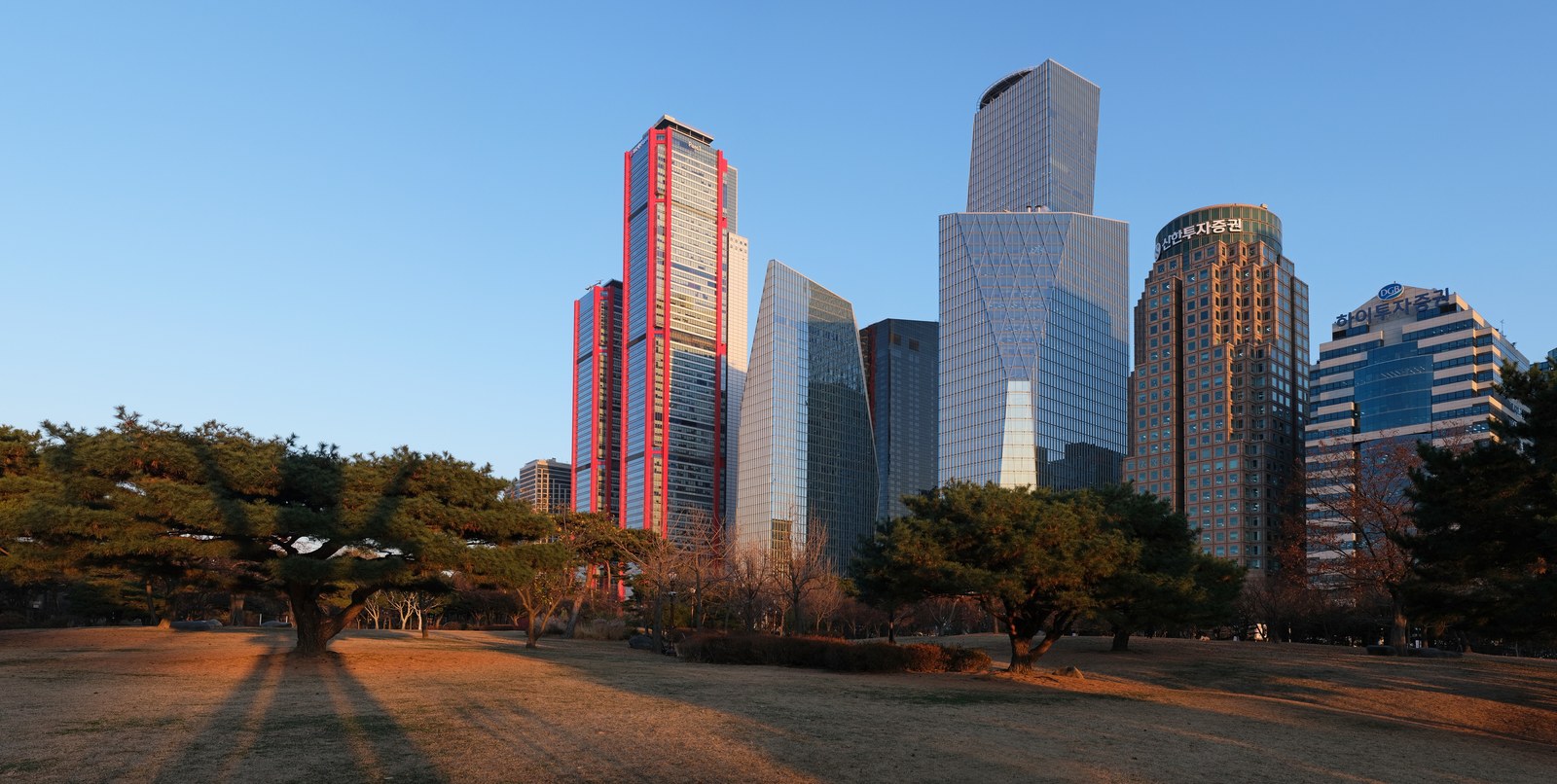
Photo: kallerna · File:Yeouido 1.jpg · CC BY-SA 4.0
After the KOSPI fell 5.21% on November 20 alone, the government turned to the stock market stabilization fund. Under the 2020 plan that set it up, the fund invests money committed by financial firms and securities-related institutions in index products such as the KOSPI 200. According to the press release from an emergency market review meeting on November 22, the government began preparations so the fund "can be deployed right away depending on market conditions." If the government decides to deploy it, how many days will it take for this money to reach the market?
The press release gives no amount to put into the fund and no date for the first injection. As items to prepare, it lists "the activation system, improving effectiveness, etc." Deputy Prime Minister and Minister of Finance and Economy Lee Hyoung-il chaired the meeting. Bank of Korea Governor Shin Hyun-song, FSC Chairman Lee Eog-weon and Financial Supervisory Service (FSS) Governor Lee Chan-jin attended.
The fund's 10.76 trillion won is money the contributing institutions promised to put in. The Financial Services Commission's (FSC) March 2020 stabilization plan built the fund on a capital call basis. When it is time to invest, the contributors are called on to pay in the amounts they committed. The first call was set at "around 3 trillion won."
The commitment consists of 10 trillion won from 23 financial firms and 760 billion won from four securities-related institutions. According to a BizWatch report, Korea Development Bank committed the most, at 2 trillion won. KB, Woori, Hana and Shinhan financial groups committed 1 trillion won each, and NongHyup Financial Group committed 700 billion won. At the March 24 announcement, the total was 10.7 trillion won. It became 10.76 trillion won after the related institutions' share grew.
In 2020, it took 16 days from the announcement until the first money was put to work. The related institutions' fund launched on March 25, and the financial firms signed an agreement on March 31. Even after the launch and the agreement, investment guidelines and payment procedures remained. The investment management committee, which sets the investment direction, held its first meeting on April 6. According to a Newsis report, the guideline set then was a broad framework: "funds will be injected when the index plunges below a certain level."
The fund began operating on April 9. According to BizWatch, the money it started with was 1 trillion won that came in first out of the 3 trillion won first call. That day, the KOSPI stood at 1,836.21, 26.0% above its March 19 low (NEXT calculation). BizWatch reported that the market had rebounded, so there was no longer an urgent reason to put money in. This 1 trillion won did not buy index products and was first placed in MMFs. MMFs are short-term financial products that can be withdrawn at any time.
According to a Korea Institute of Finance report, the fund was not deployed after that either. The report wrote that "the 2020 and 2022 funds were not actually deployed." The money went unused, but the commitments were renewed. In October 2022, the FSC carried out "a renewal of the commitments for timely reactivation." Then in December 2024, the government said it was preparing the fund "so that it can be deployed immediately at any time."
The stabilization fund last put money into stocks from November 2008 to March 2009. According to Etoday, four institutions including the Korea Exchange raised 515 billion won. The money did not go in all at once. The four institutions agreed to put in 103 billion won each month, and the injections ran from November of that year into the following spring.
Still, it is hard to judge the fund's effect by how much the index rose afterward alone. The KOSPI went from 948.69 on November 20, 2008, to 1,206.26 on March 31, 2009. The Korea Institute of Finance report found that the effect of past stabilization funds "appears limited," and that some of the effect "may have been due to other policies."
Some in the industry say an announcement has an effect even before money goes in. According to Etoday, Hana Securities analyst Lee Kyung-soo said the fund "could play the role of sending a message that the government has a contingency plan to stabilize the market, rather than actually being deployed."
Its size is also different from six years ago. The same 10.76 trillion won is now about a quarter of its former share of market capitalization. Bank of Korea data show that the commitment was 0.99% of the KOSPI market's capitalization on March 24, 2020. Based on market capitalization on November 20 this year, it is 0.27% (NEXT calculation). Foreign investors' net selling of 14.4831 trillion won on the KOSPI from November 1 to 20 is more than the full commitment (NEXT calculation).
What was new in the November 22 announcement was the phrase "deployed right away" and the list of preparations. But it does not say how large the first call will be, or how many days it will take for contributors to pay in after board approval.
How many days after a first call does the government expect the money to come in? How does this preparation differ from the "immediate deployment" preparation of December 2024? The easing of share buyback limits announced the same day will take effect on November 24 for three months after an FSC resolution on November 23. In December 2024, the government also spoke of preparing for "immediate deployment." Yet the last time the stabilization fund bought stocks is still 2008 to 2009.
*Corrected November 24: foreign net selling for November 1 to 20 now uses the sum of Bank of Korea daily data (14.4831 trillion won), and the fund's last stock purchases are dated November 2008 to March 2009 rather than "2008."*
Sources
- Ministry of Finance and Economy and related agencies, Step-by-step market stabilization measures in response to rising volatility in major stock markets (press release), November 22, 2026. Attached text items 1 to 3 (fund preparations on "the activation system, improving effectiveness, etc.," share buyback order quantity limits eased for three months from November 24, FSC resolution on November 23).
- Financial Services Commission, Financial market stabilization plan related to COVID-19, March 24, 2020. Section III-3-a (10.7 trillion won, capital call basis, first call around 3 trillion won, deployment in early April, about 700 billion won from related institutions set up first).
- Financial Services Commission, Implementation of the "100 trillion won+ livelihood and financial stability package" (press reference), March 27, 2020. Related institutions' 760 billion won fund launched March 25, financial firms' fund preparing for deployment in the second week of April.
- BizWatch, "Market safety net" stabilization fund: four major brokerages contribute 1.5 trillion won, March 31, 2020. Amounts by contributor, March 31 agreement.
- Newsis, Stabilization fund sets "investment guidelines"; detailed guidelines "not yet", April 8, 2020. Guidelines from the first investment management committee meeting on April 6.
- BizWatch, "Awkward timing as the market recovers": stabilization fund "starts" with 1 trillion won, April 9, 2020. Operations began with 1 trillion won paid in first out of the 3 trillion won first call, placed first in MMFs.
- Sisa Journal-e, Stock market stabilization fund "Dahamkke Korea" begins full operations, April 9, 2020. Total of 10.76 trillion won (10 trillion won from financial firms plus 760 billion won from related institutions).
- Financial Services Commission, Joint financial market review meeting held (press reference), October 12, 2022. Renewal of commitments.
- Financial Services Commission, Closely watching financial and foreign exchange markets and swiftly taking all measures for market stability if needed (press reference), December 5, 2024. "A stock market stabilization fund of up to 10 trillion won ... prepared so that it can be deployed immediately at any time."
- Korea Institute of Finance, A review of stock market stabilization funds: case analysis and implications (KDI Economic Information Center summary), December 13, 2023.
- Etoday, Joint fund of 515 billion won set up to stabilize the securities market, November 6, 2008. Contributions by institution, 10 funds of 51.5 billion won each, 103 billion won each month.
- Yonhap News, Will the stabilization fund be deployed for the first time in 18 years amid Black Monday fears? F4 "begins preparations" (comprehensive), November 22, 2026. Injections from November 2008 to March of the following year.
- Etoday, Talk of a "stock market stabilization fund" surfaces after KOSPI plunge: "a policy signal rather than actual deployment", November 22, 2026. Remarks by Hana Securities analyst Lee Kyung-soo.
- Seoul Economic Daily, Share buyback limits eased; short-selling rules left out despite fears of foreign outflows, November 22, 2026. No actual deployment in the 18 years after the 515 billion won injection in 2008.
- Bank of Korea ECOS 802Y001 (stock market, daily), retrieved November 23, 2026: KOSPI March 17 to 27, 2020, KOSPI April 1 to 10, 2020, KOSPI November 17 to 25, 2008, KOSPI March 25 to 31, 2009, KOSPI November 16 to 20, 2026, foreign net purchases November 1 to 20, 2026 (rows 1 to 10) and (rows 11 to 20). NEXT calculations: 10.76 trillion won divided by KOSPI market capitalization (1,083.695 trillion won on March 24, 2020, and 3,991.3978 trillion won on November 20, 2026), April 9, 2020 close divided by March 19 close minus 1, sum of foreign net purchases over 15 trading days from November 1 to 20.
Translated from the Korean original published on November 23, 2026.
Korean original: 6년간 주식 안 산 10조 증안펀드…또 '바로 가동' 준비 착수