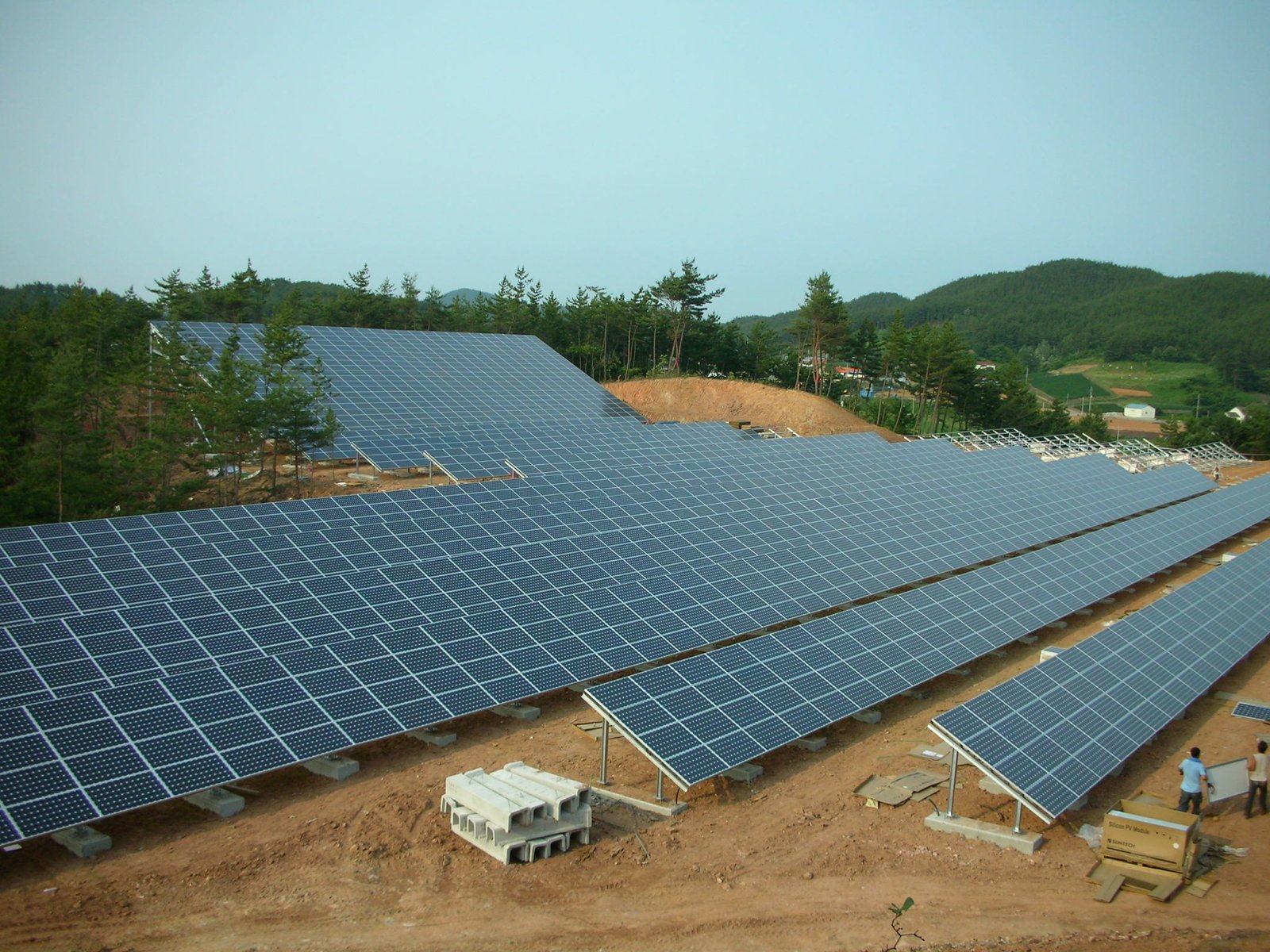
Photo: junilly · File:Taean Solar Farm by Hyosung Corporation - panoramio.jpg · CC BY 3.0
The way solar and wind power plants sell electricity changes on January 1. The Ministry of Climate, Energy and Environment will release a draft notice with the details of the new system at a briefing on November 27. A notice is a rule that a minister sets and announces under authority delegated by law. The release comes just over a month before the law takes effect. Under which system will operators who hold licenses and are now building plants sell their electricity next year?
The current system is called the Renewable Portfolio Standard (RPS). Large power companies must fill a set share of their electricity with renewable energy. Renewable energy operators earn revenue by selling Renewable Energy Certificates (RECs), which prove that output, to the power companies. The amended Renewable Energy Act, promulgated on September 15, moved new facilities to an auction system. Operators compete by bidding prices within a price cap for the volume the government announces. Winning bidders sign long-term fixed-price contracts with Korea Electric Power Corporation (KEPCO).
The broad outline of the system is already out. In an August policy guide, the government said operators would sign long-term contracts directly with KEPCO. According to an Asia Economy report, a 20-year contract plan was explained at a public hearing on September 30. According to the draft amendment to the enforcement rules, the price cap or its calculation method will be included in each auction notice.
What has not yet been decided is which power plants stay in the old system. The law's addenda set December 31, 2026, as the deadline for issuing certificates. However, operators who have received certificates by then can keep receiving and selling them under the previous rules. Operators who obtained a power generation business license before the law takes effect also stay in the old system if the minister recognizes them by notice. Which operators to recognize is not in the law and was left to the notice.
At the public hearing, the government presented a draft under review for that standard. According to Asia Economy, for solar, wind and hydro, the standard covers facilities that pass a pre-use inspection by the end of 2027. For bioenergy and fuel cells, it is the end of 2028. A pre-use inspection is a safety inspection a plant must pass before it starts operating. The plan is to keep licensed plants in the old system if they finish the inspection by then. At the time of the hearing, this standard was "under review." At the same event, Kwak Young-ju, chairman of the Korea Solar Power Generation Association, said, "Detailed transitional measures are needed so that existing operators do not suffer damage."
The draft amendments to the enforcement decree and enforcement rules, which sit above the notice, have not been promulgated yet either. The two drafts completed their pre-announcement for legislation from September 23 to November 2. The draft enforcement rules leave details to notices in twelve places, including the method for calculating the price cap (NEXT calculation). At the time of the hearing, a plan to finalize the notices and operating rules by the first quarter of next year was reported. Under that plan, some of the detailed rules will be finalized after the law takes effect.
Operators already receiving certificates are less affected. According to government guidance, the certificates they were receiving will continue to be issued for up to 20 years, and the spot market for trading certificates will stay open until the end of 2029. However, the draft enforcement decree caps the total mandatory supply that power companies must fill at the 2026 level. This total can also be reduced if reasons such as contract expiration arise. This means that even if more plants stay in the old system, the mandatory volume will not increase.
The price cap is also linked to electricity bills. Under the law, KEPCO can recover the purchase costs it pays winning bidders by reflecting them in electricity rates. The government says competition within the price cap will gradually lower purchase prices. By contrast, Kim Myung-ryong, chairman of the National Solar Power Association, said at the hearing, "If the government focuses only on lowering the price cap, it could dampen operators' willingness to take part in the market and instead harm the spread of renewable energy."
There are two questions for the government to answer. When will the standard for keeping plants that only have licenses and have not yet received certificates in the old system be finalized? When will the volume and price cap for the first auction be announced?
The briefing will be held at 9 a.m. on November 27 and will also be streamed on the YouTube channels of the Ministry of Climate, Energy and Environment and the Korea Energy Agency. An administrative pre-announcement of the notice will follow. The basic plan for the auction system with long-term contracts with KEPCO was made public in August. But which system plants under construction will use to sell electricity next year will come out as a draft only a little over a month before the system takes effect.
Sources
- Ministry of Climate, Energy and Environment, "Introducing the renewable energy deployment system and policies that change from 2027" (press release, reposted on Korea.kr), November 23, 2026. Attached PDF: briefing on November 27, administrative pre-announcement planned after releasing drafts of the contract market notice and the amended RPS management and operation guidelines, subordinate legislation "has completed the pre-announcement for legislation and the amendment process is under way," spot market grace period until December 31, 2029.
- National Law Information Center, Act on the Promotion of the Development, Use and Diffusion of Renewable Energy (Act No. 21943, version in force January 1, 2027), promulgated September 15, 2026. Article 12-14 (contract market, reflecting purchase costs in electricity rates), Addenda Articles 1 to 3 (effective date, certificate issuance deadline of December 31, 2026, licensed operators recognized by notice).
- Ministry of Government Legislation, pre-announcement of the partial amendment to the Enforcement Decree of the same Act (Notice No. 2026-887), September 23 to November 2, 2026. Total mandatory supply fixed at the 2026 total, monthly settlement of differences for obligated purchasers.
- Ministry of Government Legislation, pre-announcement of the partial amendment to the Enforcement Rules of the same Act (Notice No. 2026-888), September 23 to November 2, 2026. Draft Article 2-7 (contract notice to include "the price cap or its calculation method"), Article 2-8 (price cap calculation method set by notice). NEXT calculation method: counted the wording in the draft articles (before the addenda) that leaves matters to a ministerial notice (one place each in Articles 2-7, 2-8, 2-9, 2-15 and 20; two each in Articles 2-11 and 2-13; three in Article 2-12).
- National Law Information Center, revision history of the Enforcement Decree of the Act on the Promotion of the Development, Use and Diffusion of Renewable Energy, accessed November 23, 2026. Latest amendment Presidential Decree No. 36840 (November 17, 2026, scope of hydrothermal energy).
- Korea.kr, "Renewable energy deployment system changes for the first time in 15 years", August 21, 2026. Long-term contracts with KEPCO, existing RECs issued for up to 20 years, spot market until 2029.
- Asia Economy, "Preferential prices, two-way CfDs... how the renewable energy system will change", October 1, 2026. September 30 public hearing: 20-year fixed-price contracts, monthly settlement of differences, plan to finalize notices and operating rules by the first quarter of next year, draft pre-use inspection standard under review, remarks by chairmen Kwak Young-ju and Kim Myung-ryong.
Translated from the Korean original published on November 23, 2026.
Korean original: 짓고 있는 태양광은 옛 제도냐 입찰제냐…1월 시행 앞 기준은 아직 초안