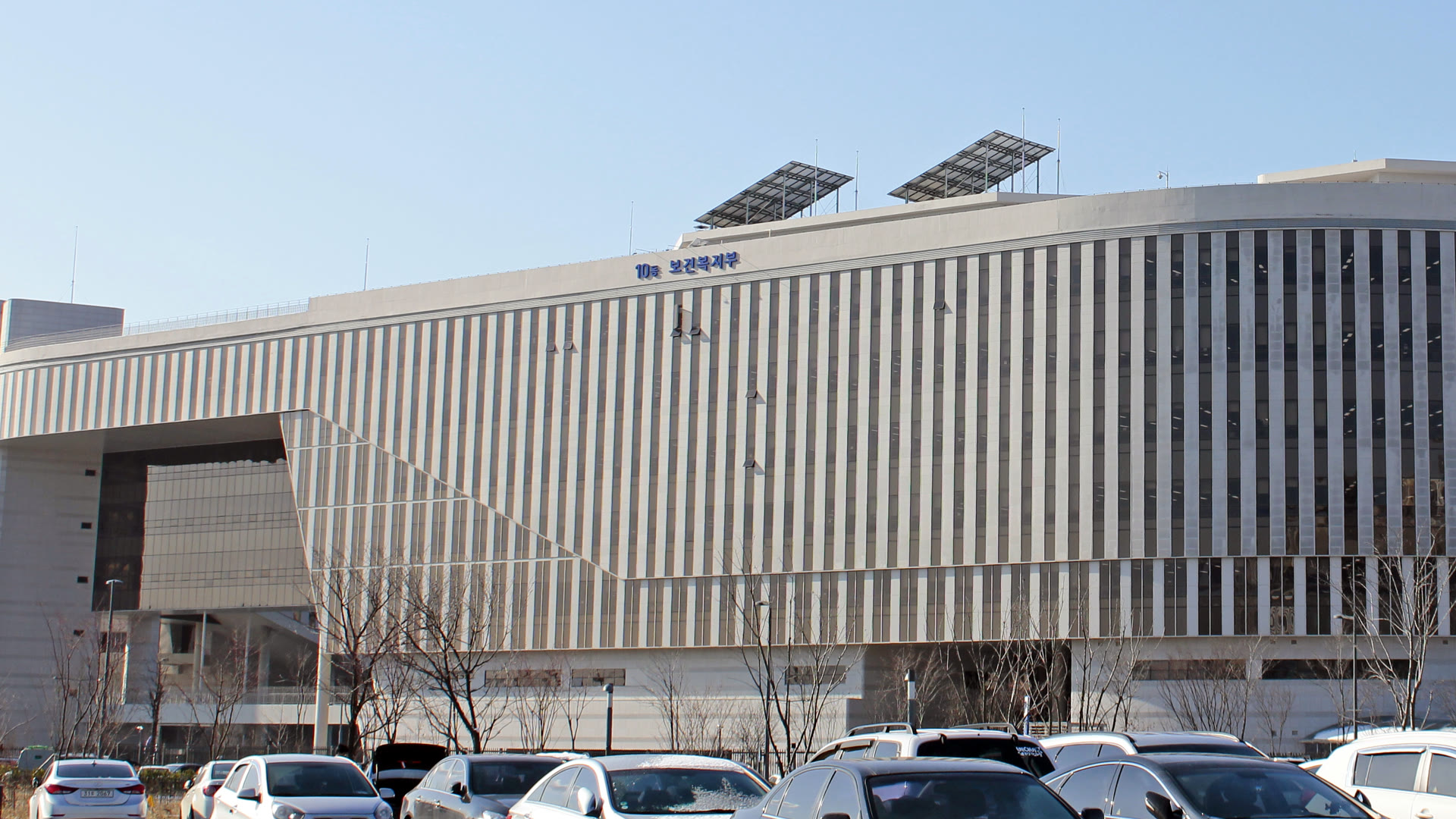
Photo: Minseong Kim (IMKSv) · Ministry of Health and Welfare(South Korea).JPG · CC BY-SA 4.0
The Ministry of Health and Welfare announced the Fourth Comprehensive Plan for Basic Living Security (2027-2029) on November 23. The ministry projected that livelihood benefit recipients will rise by 270,000, from 1.94 million at the end of June this year to 2.21 million in 2029. The livelihood benefit is money the state pays to make up the gap when a household's income falls below a government threshold. That threshold is 32% of standard median income, a benchmark based on the midpoint of household income. The plan keeps this rate through next year, then raises it by one percentage point a year from 2028 to reach 35% in 2030. The third plan, three years ago, also named 35% as its goal. What has changed this time, and how much will it cost?
What differs from the third plan is that a year is now attached to the 35% goal. The third plan (2024-2026) said only that the rate would be "gradually raised to 35% of standard median income going forward." The year-by-year schedule in the full plan carries the same wording. Some press reports at the time described the goal as 35% in 2026.
Civic groups see the new plan as a delayed promise. The People's Solidarity for Participatory Democracy (PSPD) wrote "promise delayed by four years" in the title of its November 23 commentary. Because the third plan's documents did not name 2026, no year was delayed on paper. But during the third plan the rate moved only once, from 30% to 32% in 2024. Counting next year's standard, the rate will have stayed at 32% for four years.
Benefit amounts rose even while the rate stayed at 32%. That is because standard median income itself rose by rates in the 6% range each year. The maximum benefit for a four-person household goes from 1,833,572 won a month in 2024 to 2,217,563 won next year, an increase of 20.9% (NEXT calculation). The number of recipients has also already passed the 1,807,000 that the third plan projected for 2026.
On the fourth plan's schedule, 35% falls outside the plan period. The target for 2029, when the plan ends, is 34%. Under the stated schedule, the last percentage point comes in 2030, after this plan is over.
An evaluation is also scheduled for 2029, the year before the final increase. The plan says that in that year it will assess whether the level of support is adequate, along with the number of recipients and the effect on poverty reduction. The plan does not say whether the evaluation's results could change the 35% target for 2030.
The cost of raising the threshold is not in the plan either. The 61-page full plan and the press release give no total budget figure for raising the livelihood benefit threshold. The number came from a ministry official's explanation. The official told The Chosun Ilbo that "raising the eligibility threshold by one percentage point costs about 600 billion to 700 billion won."
According to Maeil Business Newspaper, the per-point estimate assumes standard median income stays at its current level. On the same assumption, raising the rate by three points, from 32% to 35%, would add 1.8 trillion to 2.1 trillion won in the year the rate reaches 35% (NEXT calculation). That is about one-fifth of the 9.2 trillion won livelihood benefit budget for 2026. If median income rises, the amount needed could grow further.
The timing of the increases is not final either. A ministry official told Maeil Business Newspaper that "from the 2028 tasks onward, the budget has not been finalized, so we are at the stage of reviewing the timing of implementation and other matters." The 2028 rate will be set next summer by the Central Living Security Committee, which decides basic living security standards, and the money will then go into the budget proposal.
The ministry cited growth in the poor population as its reason for raising the threshold. According to the plan, the number of people at or below 50% of standard median income rose from 3.25 million in 2021 to 3.94 million in 2024. The share of them receiving livelihood, medical, housing or education benefits fell from 69.8% to 65.3%.
How much more will be spent each year from 2028 to 2030? Will 35% in 2030 stand regardless of the 2029 evaluation? The first amount will appear in the 2028 budget proposal that follows next summer's meeting.
The ministry projected 270,000 more recipients, but the plan does not state the total budget or the year-by-year cost of raising the threshold.
Sources
- Ministry of Health and Welfare, press release and full text of the Fourth Comprehensive Plan for Basic Living Security (2027-2029), November 23, 2026. Attachment 2, "What will change in three years"; Attachment 4 (2026 budget and recipients); full plan section 1-1 (livelihood benefit) and the table on benefit coverage of the poor.
- Ministry of Health and Welfare, press release and full text of the Third Comprehensive Plan for Basic Living Security (2024-2026), September 19, 2023. Schedule by detailed task in the full plan; "What will change in three years."
- Ministry of Health and Welfare, 2027 standard median income and eligibility thresholds by benefit, July 28, 2026.
- The Chosun Ilbo, "Government to add 270,000 livelihood benefit recipients by 2029", November 24, 2026.
- Maeil Business Newspaper, "Livelihood benefit eligibility expanded by 270,000", November 23, 2026.
- People's Solidarity for Participatory Democracy, commentary on the Fourth Comprehensive Plan for Basic Living Security, November 23, 2026.
- Kookmin Ilbo, "Livelihood benefit threshold eased to 35% of median income", September 19, 2023.
- NEXT calculations: the increase in the maximum benefit for a four-person household is 2,217,563 won ÷ 1,833,572 won. The cost of three percentage points is the ministry official's 600 billion to 700 billion won per point × 3.
Translated from the Korean original published on November 24, 2026.
Korean original: 생계급여 받는 사람 27만 명 늘어날 전망…해마다 드는 돈은 계획에 없어