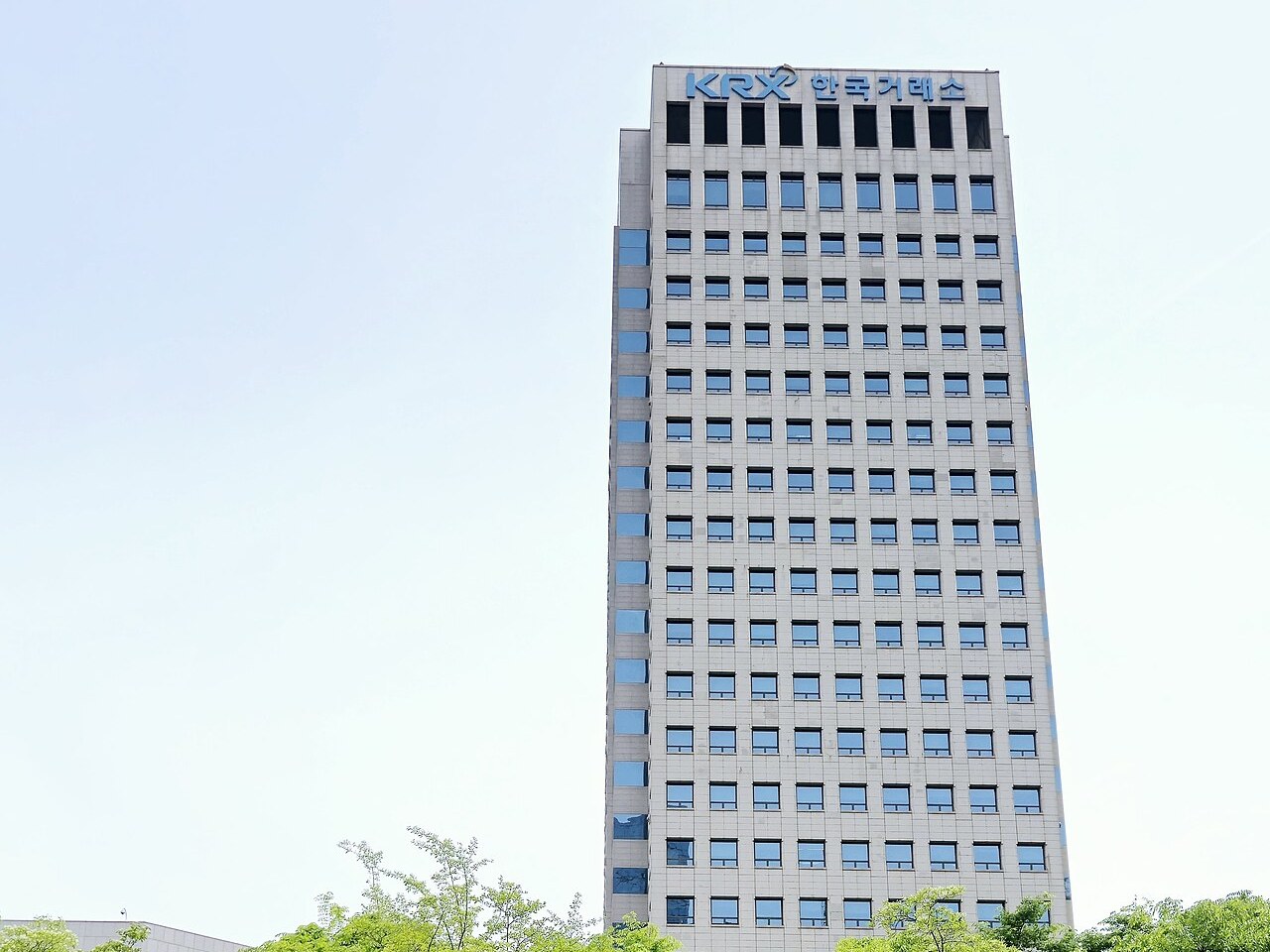
Photo: Narubaru7 · File:한국거래소 2025.jpg · CC BY 4.0
Taiwan's Financial Supervisory Commission said in a statement on November 21 that it will impose a price restriction on short selling for all stocks from November 23. In the same week, the KOSPI closed on November 20 at 4,869.96, 7.95% below its November 13 close. The South Korean government also has tools to block short selling and put money into the stock market. Can investors facing the market on Monday, November 23, know under what conditions those tools are used?
Short selling is a trade in which an investor borrows shares, sells them first, and later buys shares to pay them back. In Taiwan, from November 23, such orders cannot be placed at prices below the previous day's close. The only exception is short selling by securities and futures firms to reduce risks arising from their business. Taiwan also raised the minimum deposit that short sellers must put up from 130% to 150% of the amount sold.
This is the third time this month that Taiwan has tightened short selling. According to the Financial Supervisory Commission's November 19 statement, on November 9 it reduced the volume of borrowed shares that can be sold during the trading day. Then from November 20, stocks that fell 3.5% or more in a day faced the same price restriction the next day. According to Taiwan's Central News Agency, the National Financial Stabilization Fund, a government fund, also decided on November 6 to intervene in the market for the 10th time. Even so, Taiwan's TAIEX fell 6.23% on November 20.
South Korean law states the condition for blocking short selling across the whole market in a single line. Under the Financial Investment Services and Capital Markets Act, the Financial Services Commission (FSC) may restrict short selling "where there is concern of undermining the stability of the securities market and fair price formation." When the exchange requests it, the FSC sets the stocks and the period and blocks short selling. The enforcement decree also has no number for how far an index must fall before the tool is used.
There are two precedents for blocking short selling across the whole market. The first was in March 2020, when the FSC blocked short selling of all listed stocks for six months at an extraordinary meeting on March 13. The press release at the time cited the KOSPI's fall from 1,987.01 to 1,771.44 in two weeks. The ban was extended twice, and short selling of large-cap stocks reopened only in May 2021.
The second full ban, in November 2023, had a different reason. The FSC cited the KOSPI's 10.0% fall over three months from late July. It also noted a series of cases in which global investment banks were caught in illegal short selling, selling shares without borrowing them. This ban was extended once and lifted on March 31, 2025.
This October the market fell further than that, but no short-selling ban came. According to the Bank of Korea's ECOS, the KOSPI fell 20.7% from October 2 to 15. That is nearly twice the 10.8% drop in the two weeks before the 2020 ban (NEXT calculation). The FSC held an emergency review meeting on October 15 and said it would respond to illegal short selling with a "zero tolerance principle."
In November, too, the government brought out different measures. On November 6, Deputy Prime Minister and Minister of Finance and Economy Lee Hyoung-il held a market situation review meeting. Securities firms are required to keep a collateral ratio of at least 140% on shares bought with borrowed money. The government waived this requirement for three months. For the next stage, it wrote only that it is "preparing additional measures." But the meeting materials do not say which measures would be used at what level.
By contrast, the numbers for tools that deal with a single stock are public. The Korea Exchange, as a rule, does not allow short-sale orders at or below the last traded price. Take a day when a KOSPI stock falls 10% or more. If short-selling turnover in that stock that day is at least six times its average over the previous 40 trading days, the exchange blocks short selling the next day. Decisions to block short selling across the whole market have no such numbers.
According to a News1 report, there is also no separate law that sets the activation requirements and decision procedure for the stock market stabilization fund. In March 2020, the government created the fund with 10.7 trillion won pledged by financial companies and securities-related institutions. When the stock market falls sharply, the fund pools money and buys index products such as those tracking the KOSPI 200. Taiwan wrote the conditions for the National Financial Stabilization Fund to enter the market into law. When there is concern that market order will collapse, the fund's committee intervenes by resolution.
The evidence that short-selling bans support stock prices is weak. The Beber and Pagano study, which analyzed short-selling bans in many countries in 2007 to 2009, concluded that the bans made shares harder to buy and sell. It found that any effect of supporting prices may have existed only for U.S. financial stocks. According to FSC materials, in 2020 the KOSPI also kept falling for four more days right after the ban, down to 1,457.6 on March 19.
The FSC chairman is also cautious about activating the stabilization fund. According to a Newspim report, FSC Chairman Lee Eog-weon said at a meeting with reporters on November 13 that discussion is needed on "whether we must go in unconditionally whenever there is volatility, or whether we should go in when it reaches the level of systemic risk in the market."
What situations does the FSC see as a "concern" of undermining the stability of the securities market? Does the stabilization fund come out based on the size of the index drop or on foreign selling? The waiver of the collateral ratio on margin loans runs until early February next year, and Taiwan's new short-selling rules apply from the November 23 session. When a short-selling ban or the stabilization fund will be used is not written in numbers, either in South Korean law or in the materials from the November 6 meeting.
Sources
- Taiwan Financial Supervisory Commission, announcement of five measures including a "full ban on short selling below the previous close", November 21, 2026. In force from November 23: ban on short selling below the previous day's close (exception for hedging trades by securities and futures firms), minimum securities lending deposit raised from 130% to 150%, suspension of new listing applications for put warrants, encouragement of share buybacks, recommendation to suspend share lending.
- Taiwan Financial Supervisory Commission, ban on next-day short selling below the previous close for stocks that fell 3.5% or more in a day, and other measures, November 19, 2026. In force from November 20; mentions the measure in force from November 9.
- Central News Agency (CNA), National Financial Stabilization Fund enters the market for the 10th time, November 9, 2026. Resolution on November 6, available funds of 500 billion Taiwan dollars.
- Taiwan Laws and Regulations Database, Act Governing the Establishment and Management of the National Financial Stabilization Fund, Article 8 (conditions for intervention, report to the Legislative Yuan within three months).
- Yonhap News Agency, Taiwan bans short selling below the previous close after repeated market plunges, November 21, 2026. TAIEX fell 6.23% on November 20.
- Yonhap News Agency, Nasdaq plunges 5.3% on tech selloff, November 21, 2026. Nasdaq fell 5.28%, Nvidia fell 14.01%.
- Bank of Korea ECOS, KOSPI daily closes (November 12 to 20), accessed November 22, 2026. 5,290.53 on November 13, 4,869.96 on November 20 (NEXT calculation: 7.95% drop).
- Bank of Korea ECOS, KOSPI daily closes (October 1 to 16), accessed November 22, 2026. 7,003.74 on October 2, 5,554.22 on October 15 (NEXT calculation: 20.7% drop).
- Korea Law Information Center, Financial Investment Services and Capital Markets Act (Act No. 21647), in force from November 13, 2026. Article 180(3).
- Korea Law Information Center, Enforcement Decree of the same act (Presidential Decree No. 36823), in force from November 13, 2026. Article 208.
- Financial Services Commission, short-selling ban and expanded limit on treasury stock purchases for six months, March 13, 2020.
- Financial Services Commission, short-selling ban extended to May 2, partial resumption from May 3, February 3, 2021. Extension on August 27, 2020; four days of decline right after the ban (1,457.6 on March 19).
- Financial Services Commission, financial market stabilization measures related to COVID-19 (stock market stabilization fund of 10.7 trillion won), March 24, 2020.
- Financial Services Commission, full ban on short selling until the first half of next year, November 5, 2023.
- Financial Services Commission, full resumption of short selling from March 31, March 21, 2025.
- Financial Services Commission, emergency stock market review meeting with related institutions, October 15, 2026.
- Financial Services Commission, step-by-step response measures activated as volatility grows in domestic and global stock markets, November 6, 2026.
- Korea Exchange data system, short selling Q&A (uptick rule), accessed November 22, 2026.
- Korea Exchange data system, criteria for designating stocks with overheated short selling, accessed November 22, 2026.
- Financial News (News1), KOSPI market cap grew fourfold, but the stabilization fund has stayed at 10 trillion won for six years, limiting defense against plunges, November 20, 2026.
- Newspim, FSC Chairman Lee Eog-weon's remarks on the stabilization fund, November 13, 2026.
- Beber and Pagano, Short-Selling Bans Around the World: Evidence from the 2007-09 Crisis, Journal of Finance 68(1), 2013.
Translated from the Korean original published on November 22, 2026.
Korean original: 코스피 20% 빠져도 공매도 금지 없었다…언제 막는지 숫자 없는 법