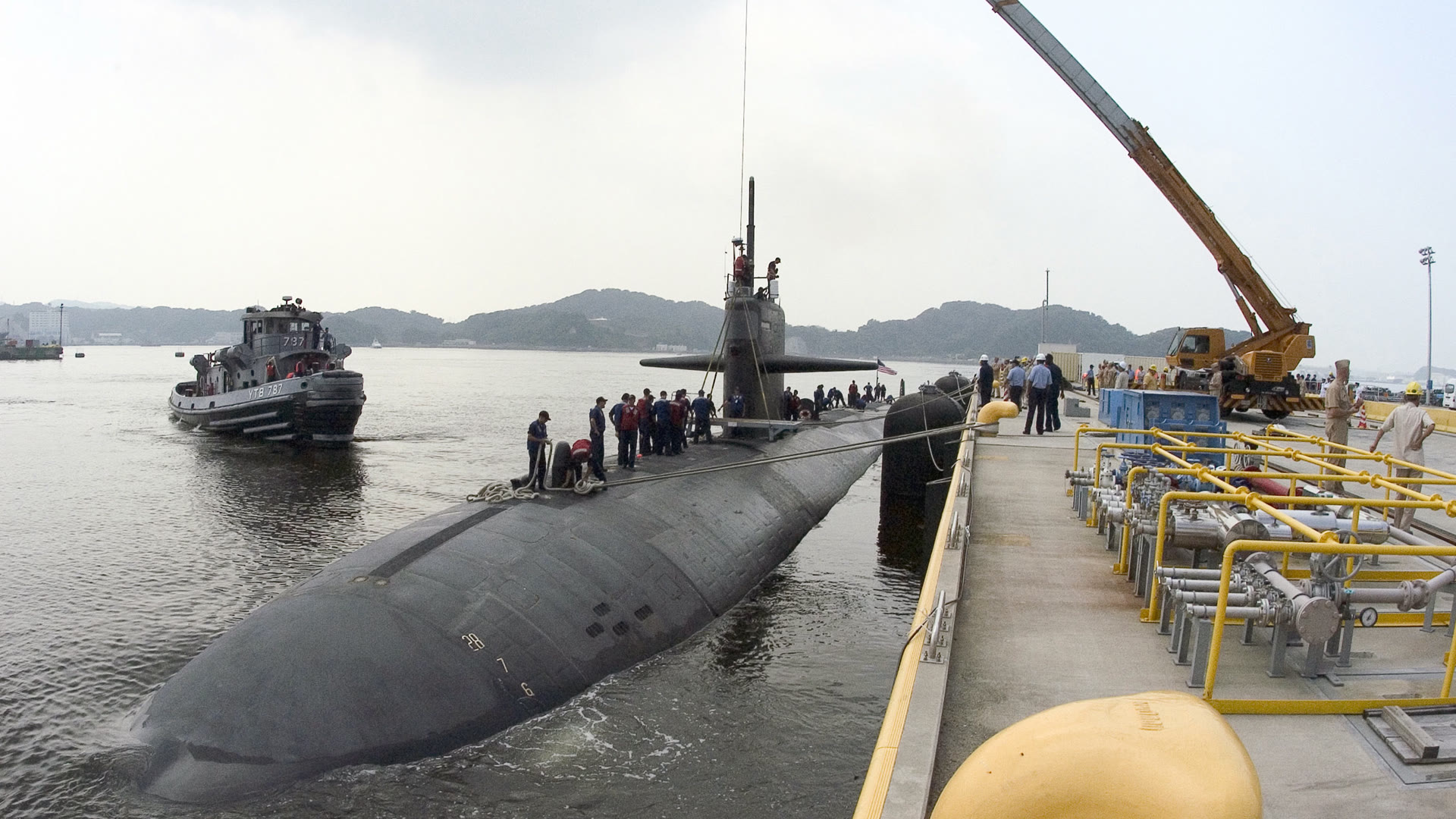
Photo: U.S. Navy photo by Mass Communication Specialist 3rd Class Matthew R. White · File:US Navy 070627-N-1251W-004 A crane lowers the brow to the Los Angeles-class attack submarine USS Chicago (SSN 721) on board Commander Fleet Activities Yokosuka, Japan.jpg · 퍼블릭 도메인(미 연방정부 저작물)
The Japanese government plans to write an exception for bringing in nuclear weapons into a national strategy document. On the 20th, Kyodo News, citing multiple officials, reported on the government's draft of the three security documents to be revised at year-end. The three security documents are the National Security Strategy, the National Defense Strategy and the Defense Buildup Program. The draft says Japan will keep its three non-nuclear principles but allows nuclear weapons to be brought in as an exception in an emergency. On nuclear-powered submarines, it says the government will "begin a review and reach a conclusion early." Korea also comes up in this debate. Defense Minister Shinjiro Koizumi, in the Diet on November 18 last year, cited the nuclear submarine plans of Korea and Australia as examples of the changing environment around Japan. What is Japan, which pledged not to bring in nuclear weapons, trying to change?
The three non-nuclear principles are the basic policy of Japan's nuclear stance: not possessing, not producing and not permitting the introduction of nuclear weapons. The current National Security Strategy, revised in December 2022, also states that the policy of upholding these principles will not change. If the draft is adopted as is, the principles and the exception will appear in the same document.
The exception itself already existed in a Diet answer 16 years ago. Katsuya Okada, then foreign minister, answered a hypothetical emergency question at the House of Representatives Committee on Foreign Affairs on March 17, 2010. According to the minutes, he gave this case: a time when refusing a temporary port call by a ship carrying nuclear weapons would leave Japan unable to protect its security. His answer was to the effect that the government of the day would decide, staking its fate on it, and explain to the public.
The new draft moves that exception from a Diet answer into a national strategy document. Prime Minister Sanae Takaichi said at the House of Representatives Budget Committee on October 14 that the wording of Okada's answer leaves "room for review." Kyodo News said the government had until then said it would carry on that answer, and reported that its position had changed. But the prime minister said she would not prejudge what would be written in the documents or how.
Yonhap News Agency linked the exception to the U.S. nuclear-armed sea-launched cruise missile (SLCM-N). According to Yonhap, port calls in Japan by submarines carrying this missile are cited as an issue related to the entry exception. But the missile's name does not appear in the draft content Kyodo News reported. According to the U.S. Congressional Research Service, Congress required that limited operational deployment of this missile be possible by September 2032.
Nuclear submarines clash with the interpretation of Japanese law. The Atomic Energy Basic Act limits the use of nuclear energy to peaceful purposes. In 1965, Kiichi Aichi, director general of the Science and Technology Agency, interpreted this provision in the Diet. His answer was that while using nuclear energy to propel ships is not yet common, using it to propel Self-Defense Forces vessels is not permitted either.
The Japanese government kept this view a year ago. A government written answer on November 28 last year said there was no change to the 1965 view that the general use of nuclear propulsion was beyond imagination. The same written answer said no private company in Japan owns a nuclear-powered ship.
Even so, the draft sets a schedule that assumes nuclear submarines will be introduced. According to Kyodo News, the government envisions starting related projects early within five years from fiscal 2027. The needed budget will be set as research funds. According to Kyodo News, the core of the administration points out that nuclear submarines can carry vertical launch systems for missiles.
The cost is a heavy burden. According to Yonhap, a nuclear submarine costs 1 trillion yen (about 8.49 trillion won) per boat to develop and maintain. The agency reported that at least three are needed to rotate through operations, maintenance and standby.
There is no guarantee the draft will be adopted as is. According to Kyodo News, the draft is close to the position of the Japan Innovation Party, a coalition partner eager for nuclear submarines and for revising the three principles. In the Liberal Democratic Party, by contrast, there is caution over nuclear proliferation and a regional arms race. Kyodo News reported that the draft could change as the government and ruling parties coordinate. Hiroshima Mayor Kazumi Matsui said at a press conference on November 11 that the three non-nuclear principles should not be treated lightly. He said that should be so if the principles are a means of showing that Japan is a peaceful nation.
Compared with Korea, the two countries are at different stages. In Korea, the Defense Acquisition Program Administration plans to launch the first boat in the mid-2030s. Korea held its first technical consultation with the International Atomic Energy Agency (IAEA) on October 8. The consultation deals with the arrangement made when nuclear submarine fuel is used for military purposes. Japan, by contrast, must first decide again how to read its own law before any such consultation.
Questions remain for the Japanese government to answer. Is the draft's entry exception limited to temporary port calls by ships carrying nuclear weapons, as in Okada's answer? If it changes the 1965 interpretation, how will it explain the peaceful-purpose provision of the Atomic Energy Basic Act? According to Kyodo News, the government's expert panel will submit its report in early December. The government will then revise the three security documents at year-end. If the draft is adopted, an exception that has existed only in a Diet answer for 16 years will be written into Japan's national strategy document.
Sources
- Kyodo News (carried by Kumamoto Nichinichi Shimbun), government draft: nuclear submarines "review, early conclusion" and written exception to the three non-nuclear principles, November 20, 2026.
- House of Councillors of Japan, written answer to a question on considering nuclear submarine ownership (Cabinet answer, House of Councillors 219 No. 46), November 28, 2025. Cites Defense Minister Koizumi's November 18, 2025 answer, maintains the 1965 view, and addresses private nuclear-powered ships.
- House of Councillors of Japan, written question on considering nuclear submarine ownership (219th Diet, No. 46), November 2025. Cites the 1965 answer by Science and Technology Agency Director General Aichi.
- Cabinet Secretariat of Japan, National Security Strategy (December 2022), wording on upholding the three non-nuclear principles.
- House of Representatives of Japan, Committee on Foreign Affairs minutes, March 17, 2010. Foreign Minister Okada's answer.
- Kyodo News (carried by Kumamoto Nichinichi Shimbun), Prime Minister Takaichi: "room for review in the wording", October 14, 2026.
- Yonhap News Agency, Japan steps up review of nuclear-powered submarines; "exception to nuclear entry ban" also to be written in, November 21, 2026.
- U.S. Congressional Research Service (CRS), Nuclear-Armed Sea-Launched Cruise Missile (SLCM-N), IF12084, January 8, 2026. Section 1633 of the National Defense Authorization Act for Fiscal Year 2026.
- Japan e-Gov law search, Atomic Energy Basic Act, Article 2, Paragraph 1.
- Kyodo News (carried by Kumamoto Nichinichi Shimbun), Hiroshima mayor's press conference, November 11, 2026.
- Kyodo News (carried by Kumamoto Nichinichi Shimbun), LDP Research Commission on Security meeting and expert panel report schedule, November 11, 2026.
- NEXT, IAEA "satisfied" with the 29 trillion won nuclear submarine, but the fuel arrangement is only at its first consultation, November 20, 2026.
Translated from the Korean original published on November 21, 2026.
Korean original: 핵 실은 미국 배 들어올 수 있게…일본, 비핵 3원칙에 '긴급 시' 예외