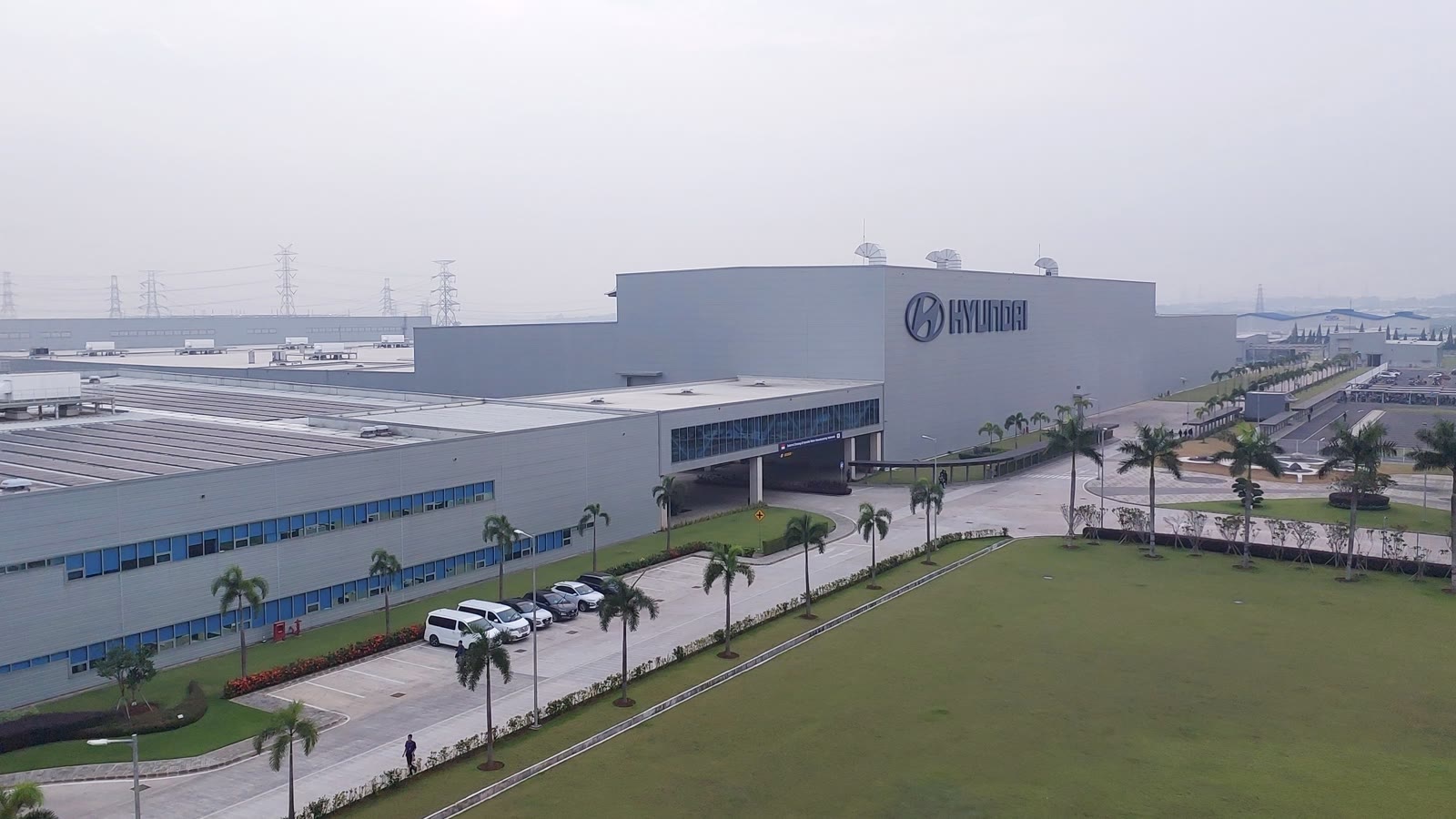
Photo: AWG97 · File:Hyundai Motor Manufacturing Indonesia (HMMI) 2023.jpg · CC BY-SA 4.0
The European Union (EU) and Indonesia signed a Comprehensive Economic Partnership Agreement (CEPA) in Brussels on November 21. Under this agreement, tariffs on most EU-made cars will disappear over five years. The current rate is up to 50%. Indonesia sells more than 1 million cars a year. Most sedans and regular passenger cars that Korea ships as finished vehicles pay a 5% tariff. When will the tariff gap that Korean cars gained first disappear?
The 5% that Korean cars pay is not the rate under the Korea-Indonesia CEPA. Two agreements between Korea and Indonesia apply to cars. One is the Korea-ASEAN FTA, which took effect in 2007. The other is the Korea-Indonesia CEPA, which took effect in January 2023. In the Indonesian Ministry of Finance's CEPA tariff schedule, sedans and regular passenger cars of 3,000cc or less are marked only "MFN." This means that through 2042 they use the general rate charged equally to all countries, with no agreement rate. The 5% is in the Korea-ASEAN FTA tariff schedule that took effect in April 2022. This schedule also charges 5% on most finished hybrid and electric passenger cars.
EU cars now pay this general rate. According to the EU schedule, the general rate for such finished cars was 50% as of January 2023. Imported electric cars from companies that pledged local investment had a tariff exemption until the end of 2025. According to a Metro TV report, the general 50% tariff applies again to imported finished electric cars from January this year.
The tariff on EU-made sedans and regular passenger cars falls from 50% to 0% over five years. The Indonesian schedule of the EU agreement puts most such finished gasoline and electric cars on a five-year schedule. Under the elimination rules, the first cut comes in the year the agreement takes effect, and the rate then falls by the same amount every January 1. It reaches 0% on the fifth January 1.
According to the European Commission's press release, the agreement is likely to be provisionally applied in early 2027 once both sides finish their domestic procedures. For example, if the agreement takes effect in 2027, the rate on EU cars becomes 33.3% in January 2028. In January 2031 it is still 8.3%, higher than the rate on Korean cars. The order changes in January 2032, when EU cars reach 0%. From then on, the same types of cars made in Korea and shipped from there pay 5 percentage points more. The rates in both agreements apply only to cars that meet the rules of origin to qualify as Korean-made or EU-made.
Korea's advantage lasts longer for hybrid cars. In the EU schedule, many finished hybrid passenger cars are on a 15-year schedule. These items are cut in 16 steps and reach 0% only on the 15th January 1. Assuming the agreement takes effect in 2027, the rate on such EU hybrid cars first falls below 5% in January 2041.
For kits of parts for local assembly, Korea's advantage will soon disappear. This is the completely knocked down (CKD) method, in which cars are brought in as parts and assembled at a local plant. Korean sedans and regular passenger cars brought in as CKD kits are at 0% in both agreements' tariff schedules. In the EU schedule, the base rate for the same items is 10%, and it goes to 0% when the agreement takes effect. Large finished passenger cars with engines over 3,000cc are already at 0% when made in Korea. Most large EU-made cars follow the five-year schedule, so this gap remains until January 2032.
Hyundai Motor makes several of the models it sells in Indonesia locally. Hyundai Motor completed a finished-car plant in Bekasi, Indonesia, in March 2022. This plant makes the Creta, Stargazer, Santa Fe and Ioniq 5, and added the Kona EV in July 2024. Cars made locally do not pay import tariffs on finished cars. The tariff gap applies only to models made in Korea and shipped from there.
The EU agreement also has provisions that cut certification procedures, apart from tariffs. According to the agreement summary, EU cars with type approval under UN standards will not undergo additional testing in Indonesia. The European Commission expects EU exports to Indonesia to grow by nearly 40% within 15 years. It named machinery, cars and metals as items likely to grow the most.
The government held the second CEPA joint committee with Indonesia in Seoul on October 28. The agenda items announced by the Ministry of Trade, Industry and Energy were approval of poultry and dairy imports and the electronic exchange of certificates of origin. Car tariffs do not appear in the press release.
Will the government open negotiations with Indonesia to lower the rate on finished passenger cars below 5% under the CEPA? Will an answer come before early 2027, when the EU agreement is to be provisionally applied? The Korea-Indonesia CEPA left the rate on finished passenger cars blank. So the tariff advantage of Korean cars rests on the 5% rate under the Korea-ASEAN FTA.
Sources
- European Commission, EU and Indonesia sign ambitious trade and investment agreements (IP/26/2532), November 21, 2026.
- European Commission Directorate-General for Trade, Key elements of the EU-Indonesia Trade Agreement and Investment Protection Agreement, accessed November 22, 2026.
- European Commission, EU-Indonesia CEPA Annex 2-A tariff elimination rules and Indonesian schedule (HS 8703), public version of the text concluded in September 2025. List of agreement texts.
- Indonesian Ministry of Finance, Finance Minister Regulation 227/PMK.010/2022 on Korea-Indonesia CEPA tariff rates (annex with yearly rates for 2023 to 2042, HS 8703), issued December 30, 2022, in force January 1, 2023.
- Indonesian Ministry of Finance, Finance Minister Regulation 45/PMK.010/2022 on Korea-ASEAN FTA tariff rates (Annex I, HS 8703), in force April 1, 2022. The reciprocal rate schedule applied only to Korean goods (Annex II) was replaced by Finance Minister Regulation 152/2023, and passenger cars (HS 8703) are not included in it.
- Indonesian Ministry of Finance, Finance Minister Regulation 223/PMK.010/2022 on RCEP tariff rates for Korean goods: most finished sedans and regular passenger cars of 3,000cc or less are marked "MFN."
- Metro TV, Insentif Dicabut, Impor Mobil Listrik Bakal Kena Tarif Normal Mulai 2026, September 15, 2025.
- Ministry of Trade, Industry and Energy, second Korea-Indonesia CEPA joint committee held (press release), October 28, 2026.
- Yonhap News Agency, EU and Indonesia conclude trade agreement, removing more than 90% of tariffs, November 21, 2026.
- Economist (Korea), Hyundai Motor completes Indonesia plant; Chairman Chung Eui-sun calls it "a key base for future mobility strategy", March 16, 2022.
- Newsis, a younger, more flexible Hyundai Motor: a visit to the Indonesia plant, July 2, 2024.
- Newsis, Hyundai Motor steps up push in Indonesia with the Ioniq 5 N after the Kona EV, July 22, 2024.
- The rate comparison is a NEXT calculation that matches the same tariff lines (Indonesian tariff book BTKI 2022) line by line across the three tariff schedules. The yearly EU rates assume the agreement takes effect in 2027. Agreement rates apply only to cars that meet the rules of origin.
Translated from the Korean original published on November 22, 2026.
Korean original: 한국차 5%·EU차 50%인 인도네시아…2032년엔 관세 순위 뒤집혀