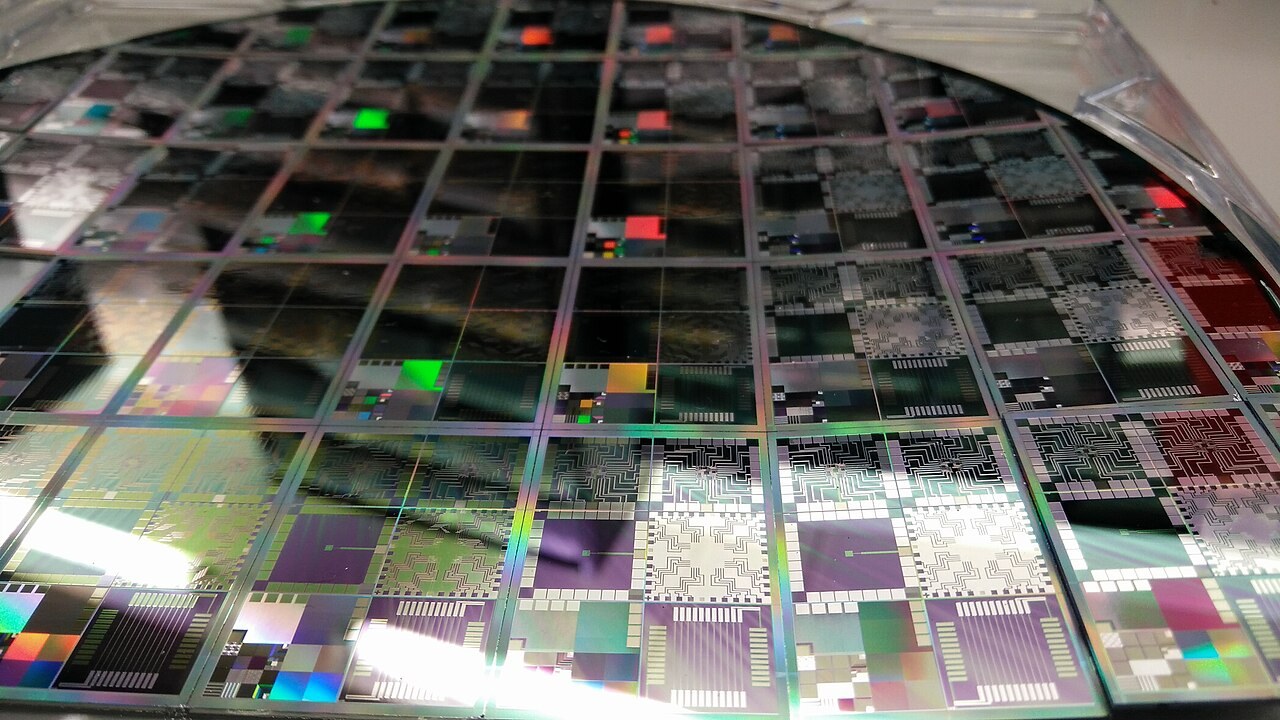
Photo: DrHughManning · File:Semiconductor Wafer of Microelectronics.jpg · CC BY-SA 4.0
From November 24, the National Assembly's Special Committee on Budget and Accounts hands disputed budget items to a closed-door negotiation known as the "sub-subcommittee." According to The Dong-A Ilbo, only the committee chair, the ruling and opposition party secretaries and others meet there in private, and no minutes are kept. One item they will fight over is support for a semiconductor cluster in Gwangju and South Jeolla Province. The government put 1.5 trillion won in next year's budget bill. But lawmakers of the Democratic Party of Korea (DP) asked to add 4.5 trillion won, raising it to 6 trillion won. If the government consents and the increase is adopted, the state would spend 4.5 trillion won more next year. Is there a plan to spend 6 trillion won in a single year?
The money is an incentive the government gives for the administrative merger of Gwangju and South Jeolla. The project name in a Ministry of Trade, Industry and Resources explanatory note is the "integrated fiscal support project for building the Southwest semiconductor cluster." The government plan puts 1.5 trillion won a year into a fund for four years, 6 trillion won in total. But the merged Jeonnam-Gwangju Integrated Special City will draw up the plan that decides what the fund spends and how much.
Under the increase request, the 6 trillion won meant to be paid over four years would all go into the first year's budget. According to The Dong-A Ilbo, lawmakers Jung Tae-ho, Kwon Hyang-yeop, Song Jae-bong and Ahn Do-geol made the request at the budget committee. Their reason was that the special city should be able to manage the cluster budget flexibly. In the same tally, the increases lawmakers sought came to 71.9228 trillion won even after subtracting the cuts they sought. This project's request is 4.5 trillion won of that.
Even for the government's 1.5 trillion won, it has not been decided how much goes to which project. According to Etoday, the budget bill lists only amounts split into five categories. For example, 1 trillion won goes to building and running infrastructure, and 200 billion won to support for companies and tenant institutions. The government called this breakdown "examples of use." The budget bill also carries a note that it "does not confirm whether individual projects will be supported or at what scale."
The process of checking the project's scale is not finished either. At a Cabinet meeting on August 25, the government exempted the project from a preliminary feasibility study, with conditions attached. A preliminary feasibility study is a procedure that checks the economic case for a large state-funded project in advance. Under the National Finance Act, a project exempted from the study still goes through a "project plan adequacy review." The results of this review, which examines scale and alternatives, are reflected in budget planning. On November 2, the Ministry of Trade, Industry and Resources said of this review that it "plans to proceed with the related procedures promptly."
The National Assembly is also still writing the legal basis for putting in the money. According to Herald Business, the condition is an amendment to the special act on the Jeonnam-Gwangju Integrated Special City. The goal is to put the basis for government payments into the fund in that law. The amendment would create a fund in the special city and set up a separate semiconductor support account in it. On November 19, the amendment passed a bill subcommittee of the Public Administration and Security Committee, led by the DP. To change the law, it still needs votes in the full committee and the plenary session.
The government says the 6 trillion won will not be spent without checks. The special city's fund management plan is finalized after review by a support committee and a vote by the local council. According to MTN, the project plan also includes settlement of accounts and performance analysis after spending. In a September explanatory note, the ministry said, "The exemption from the preliminary feasibility study does not mean that the project's content and scale are confirmed without verification."
The People Power Party (PPP), by contrast, called for cutting the entire 1.5 trillion won. According to Yonhap News Agency, the PPP said the basis for the calculation was unclear and the total payment was set before any review. Because the parties could not narrow their differences over this project, the Trade, Industry, Energy, SMEs and Startups Committee failed to approve its budget on November 13.
This dispute may be settled in a meeting that leaves no minutes. Under the National Assembly Act, subcommittee meetings are open in principle, and minutes must be kept. But the National Assembly Act has no meeting called a "sub-subcommittee." Who asked for how much more in the sub-subcommittee is not left in any official record.
Even if the sub-subcommittee agrees on the increase, the government's consent is still needed. Under the Constitution, the National Assembly cannot increase spending amounts in the budget submitted by the government without the government's consent. Adding 4.5 trillion won also requires the government's consent.
Is the scale review that the Ministry of Trade, Industry and Resources said on November 2 it would carry out "promptly" finished? Without its results, what is the basis for needing 6 trillion won in the first year? If the sub-subcommittee accepts the increase, where will the reason be recorded? The legal deadline for passing the budget is December 2. A request has been made to put four years of support into one year, for a project whose scale review the government said it would speed up.
Sources
- The Dong-A Ilbo, "72 trillion more" on top of an 820 trillion won super budget… ruling and opposition parties compete on increases, November 24, 2026.
- The Dong-A Ilbo, 162 trillion won future fund goes to the "closed-door" sub-subcommittee from today, November 24, 2026.
- Ministry of Trade, Industry and Resources explanatory note, Southwest semiconductor cluster integrated fiscal support project to be carried out reflecting a strict project adequacy review, November 2, 2026.
- Ministry of Trade, Industry and Resources explanatory note, Southwest semiconductor cluster integrated fiscal support to be carried out based on the special city's autonomy and responsibility, September 11, 2026.
- Etoday, Gwangju semiconductor cluster budget of 6 trillion won… Rep. Koo Ja-keun says "no detailed basis for calculation", September 11, 2026.
- Herald Business, 27 projects exempted from preliminary feasibility studies, including three mega projects and "5 poles, 3 special" subsidies, August 25, 2026.
- Jaekyung Ilbo, Jeonnam-Gwangju special act passes Public Administration and Security subcommittee, November 19, 2026.
- MTN, Controversy over "budget first, design later" for Honam semiconductors, September 11, 2026.
- Yonhap News Agency (reprinted by Korean Center), National Assembly trade committee fails to approve budget over Honam semiconductors and future fund, November 13, 2026.
- Korea Law Information Center, National Finance Act Article 38(2)10 and (5).
- Korea Law Information Center, National Assembly Act Article 57(5) and Article 69(4).
- Korea Law Information Center, Constitution of the Republic of Korea Article 57.
Translated from the Korean original published on November 24, 2026.
Korean original: 반도체 지원금 4년 치를 내년에 한꺼번에?…1조5천억도 세부 사업 미정