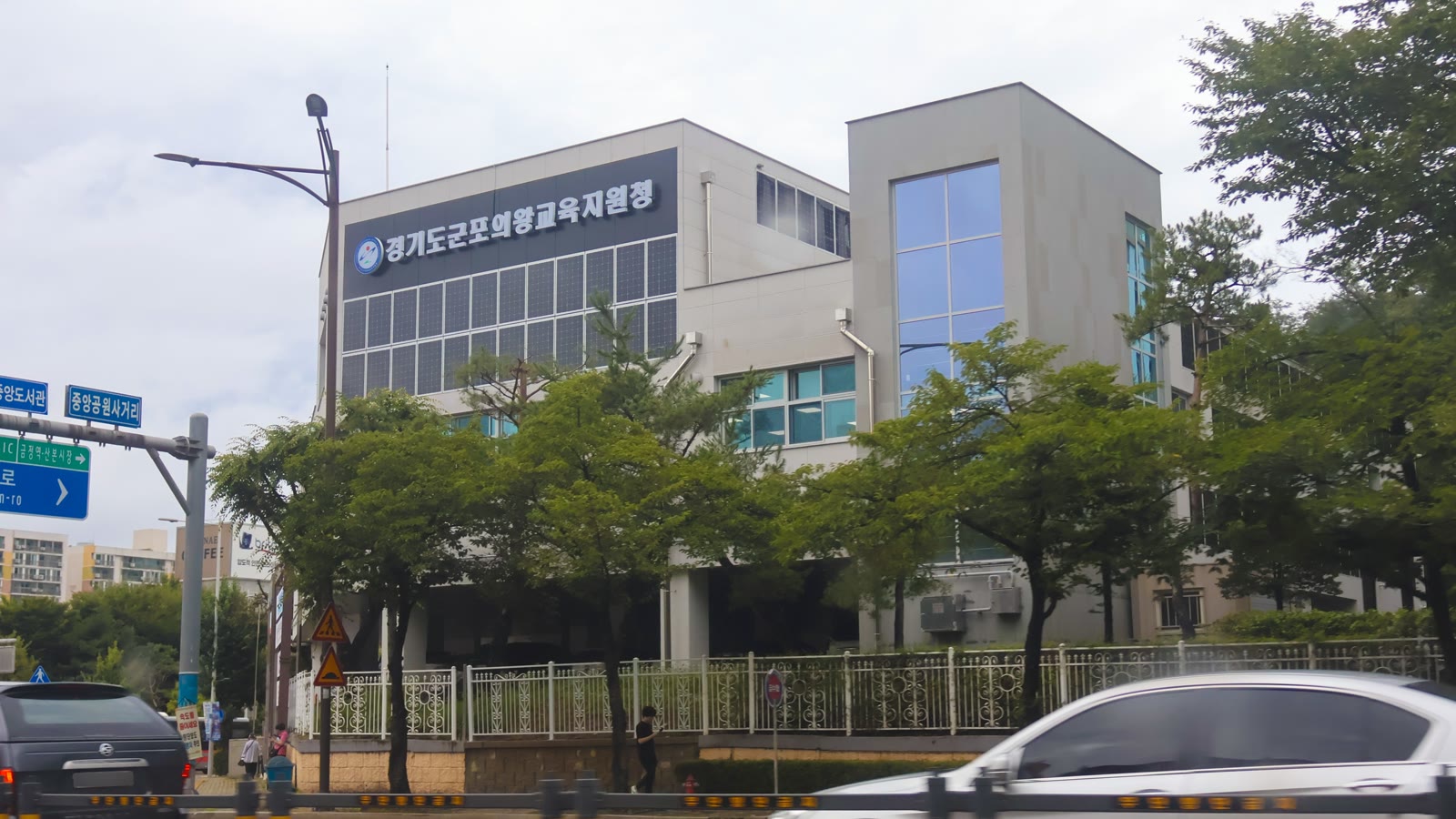
Photo: LandAndTree · File:Gunpo Uiwang Office of Education 20240722 (01).jpg · CC0 1.0
The Gyeonggi Provincial Office of Education announced on its website on November 20 that personal information of 158 teachers had leaked. The leaked information includes names, dates of birth, details of misconduct and amounts exchanged with private education companies. The documents were handed over from May 6 to 18, and six months passed before the website notice. Did the office give notice within the deadline set by law?
The leaked documents are two pieces of evidence the office submitted to the Teachers' Appeal Commission. An appeal review is the procedure through which disciplined teachers challenge their penalties. One document is data on 85 teachers who signed contracts with one private education company from 2018 to 2022. The other is an audit report on 73 teachers' participation in the private education market. The office submitted both documents without masking the personal information.
According to the office's notice, the documents were delivered to five people involved in the appeal cases. Four received the data on the 85 teachers on May 12, 15 and 18, and one received the data on the 73 teachers on May 6. The items also include each teacher's school or office, whether outside work was approved, contract dates and payment amounts. The office said there was no wide spread of the information, such as posting on the internet.
Under the Personal Information Protection Act, the deadline is counted not from the day the documents were handed over but from the day the institution learned of it. The act requires an institution that learns of a leak to notify the people affected without delay. The enforcement decree sets that deadline at 72 hours from the time of learning. The same deadline applies to the education office, a public institution. Violating the notification duty can bring a fine of up to 30 million won.
But the office's notice does not give that date. The notice says the office replaced the documents with versions with the personal information masked "immediately upon receiving notification." However, it does not say who gave the notification or when. Etoday also reported on November 21 that the notice left out the date the office became aware.
If the office learned of the leak only just before the notice, it may have met the deadline. The decree also leaves room for later notice. If urgent measures are needed to retrieve or delete the leaked information, the institution may give notice right after finishing that work. The office said it confirmed that the original documents held by the appeal commission had been destroyed.
The notice does not say that all copies held by the five people were deleted. It says the office confirmed, with their cooperation, that the information "had not been noticed or is scheduled to be destroyed." This means copies that had not been deleted may have remained as of November 20.
The decree also sets a standard for whether a website notice can replace notice to each person. The decree requires notifying the people affected by methods such as letter, email or text message. To replace this with a website posting, there must be a legitimate reason, such as not knowing their contact details. The education office is the body in charge of these teachers' personnel matters. However, since the data covers contracts from 2018 to 2022, some teachers may have left schools since then. The notice does not say whether the 158 teachers were notified separately.
For website postings, the decree also says the notice must stay up for at least 30 days so the people affected can easily find it. But this notice was posted on the general resources board. On November 22, searching the announcements board for "leak" did not bring up this post.
Unlike notification, a report to the Personal Information Protection Commission (PIPC) is not required for every leak. The decree requires a report when the information of 1,000 or more people leaked or when it leaked through illegal outside access. The same applies when sensitive information or unique identifying information such as resident registration numbers leaked. This case involves 158 people, and the leak came from documents the office itself submitted. The list of sensitive information includes health and criminal records, and there is no separate item for disciplinary misconduct.
Documents sent by mistake have also led to action by the PIPC. In July 2023, the PIPC penalized public institutions that had attached files with resident registration numbers to official letters by mistake. On the same day, this education office also received a fine of 21.6 million won. That case was a hacking incident in which the scores of about 270,000 students who took an academic assessment leaked.
Scores in the evaluation of public institutions also depend on how they respond after an incident. In this year's evaluation, the PIPC raised the maximum deduction for institutions with leaks from 10 points to 20 points. It deducts up to 5 more points if the response after an incident is inadequate. Provincial and metropolitan offices of education are also covered, and the results come out in April 2027.
From whom and when did the office receive notification? Did it notify the 158 teachers separately, apart from the website? Whether the notice was late depends on the day the office learned of the leak, and the office has not disclosed that day.
Sources
- Gyeonggi Provincial Office of Education, notice of personal information leak and results of measures taken (general resources board, Teacher Personnel Policy Division), November 20, 2026. Posting date, board, replacement "immediately upon confirming the facts."
- Gyeonggi Provincial Office of Education, guidance on measures taken following the personal information leak (attached PDF), November 20, 2026. Two documents, 85 and 73 teachers, delivery dates, five people involved, leaked items, "immediately upon receiving notification," scope of confirmed destruction.
- Yonhap News Agency, Gyeonggi Provincial Office of Education leaks personal information of 158 teachers; "destroyed immediately upon confirmation", November 21, 2026.
- Etoday, information on 158 teachers leaked in May, notice in November; Gyeonggi education office does not disclose date it became aware, November 21, 2026.
- Korea Law Information Center, Personal Information Protection Act Article 34 (leak notification and reporting), Article 75(2) (fines), Act No. 21445, version in force from September 11, 2026.
- Korea Law Information Center, Enforcement Decree of the Personal Information Protection Act Article 39 (72-hour notification, notification after urgent measures, replacement by website posting), Article 40 (reporting criteria and 72 hours, exception for retrieval or deletion), Article 18 (sensitive information), Article 19 (unique identifying information), Article 17(5) (written and similar methods), Presidential Decree No. 36804, version in force from November 10, 2026.
- Byline Network, Gyeonggi Provincial Office of Education fined 21.6 million won over academic assessment score leak, July 27, 2023. Decision at the PIPC plenary meeting on July 26, 2023.
- Herald Economy, penalty for public institutions that leak personal information expanded from 10 points to 20 points, April 12, 2026. 2026 plan for evaluating personal information protection at public institutions.
Translated from the Korean original published on November 22, 2026.
Korean original: 교원 158명 비위 내용까지 샜는데…경기교육청 '알게 된 날' 안 밝혀