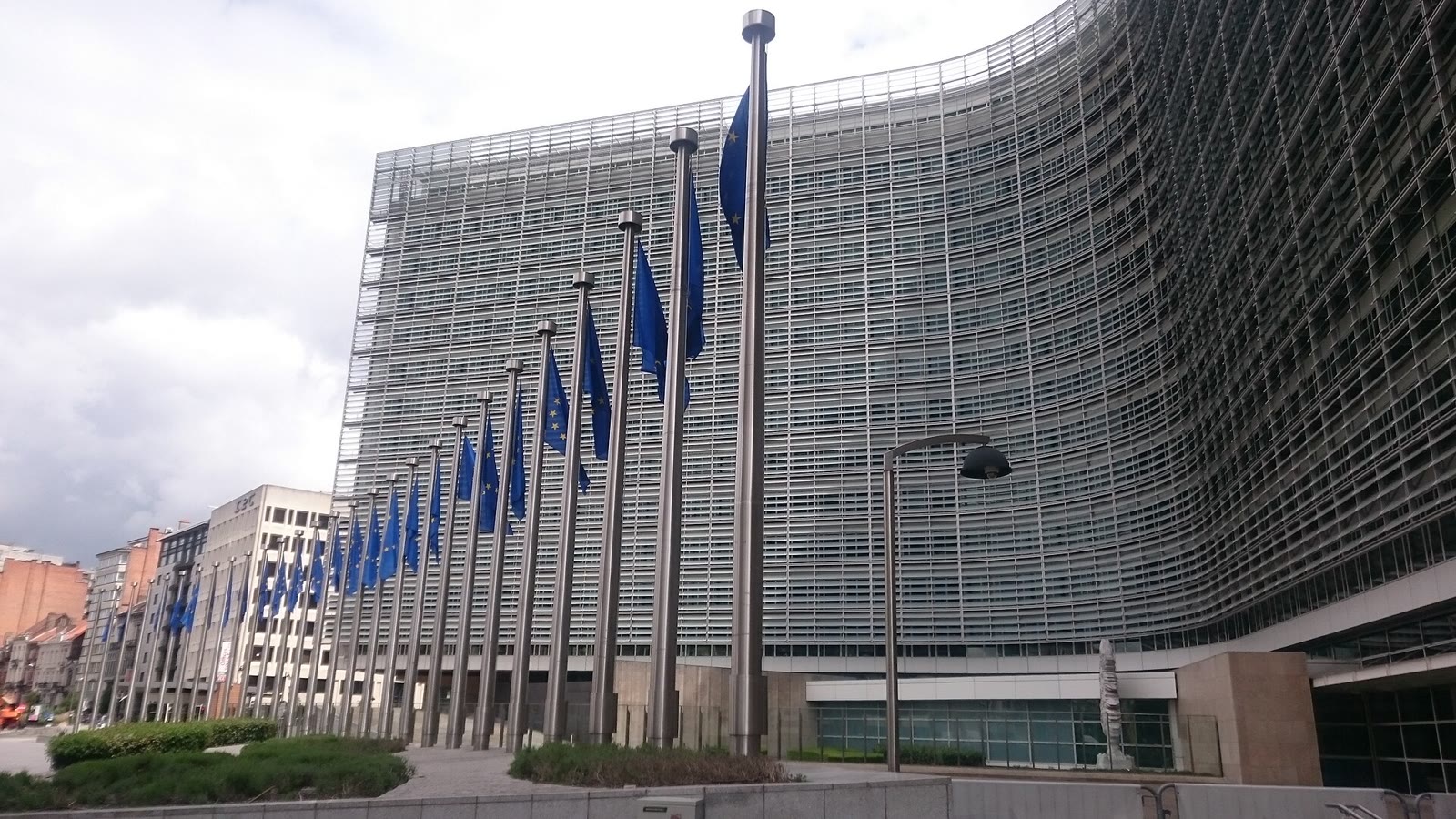
Photo: KenSwe72 · File:Berlaymont building Brussels.jpg · CC BY 4.0
António Costa, President of the European Council, put forward a new draft of the EU's 2028~2034 budget on November 21. It includes several new revenue sources the EU would collect directly to reduce member states' contributions. The newly added source in the draft conclusions for the November 26~27 summit is a levy on digital companies. Costa said it was not a tax aimed at any particular company or country. Yonhap News Agency and Reuters interpreted it as aimed mainly at U.S. big tech. But looking at the thresholds alone, Korean companies could also be caught. Who would pay this levy, and how will the U.S. respond?
There are two thresholds. According to the document, digital revenue in the EU must exceed 50 million euros (about 73.6 billion won). Global revenue must also exceed 750 million euros (about 1.1 trillion won). The won conversions use the European Central Bank's November 20 reference rate of 1,472.04 won per euro. The proposal would charge companies that cross both thresholds 3% of revenue every year. Only revenue from online advertising, online intermediation and marketplaces, and the sale of user data counts.
The collection framework is the digital services tax directive proposal the European Commission put forward in 2018. The two thresholds and the 3% rate match that proposal. The negotiating draft calls on member state ministers to restart talks on the directive proposal and reach agreement in 2027. The 2018 proposal counts subsidiaries' revenue when applying the thresholds. It excluded services whose main purpose is for the company to supply games, music or video directly.
Naver easily crosses the global revenue threshold. In the first quarter of this year alone, it posted revenue of 3.2411 trillion won, nearly three times the annual threshold.
Whether Naver is covered depends on its revenue inside the EU. In January this year Naver acquired Wallapop, a Spanish secondhand trading app. Wallapop brokers secondhand trades between individuals in Spain, Italy and Portugal. Its revenue last year was 116 million euros. More than 85 million euros of that came from "Wallapop Envíos." The company calls this business an "intermediated e-commerce service." That share alone exceeds the 50 million euro threshold.
The amount Naver would pay is small compared with the company's size. Even applying 3% to all of Wallapop's revenue last year gives 3.48 million euros, about 5.1 billion won. Which revenue counts toward the levy will be set by the directive to be rewritten.
It is also not settled whether the levy will actually be collected. According to Reuters, the budget and revenue sources are decided unanimously by the 27 countries. Irish Prime Minister Micheál Martin stated his opposition. He said that if the EU imposed a digital tax on its own, Europe would lose a lot of investment. Collection would also start late. Under the negotiating draft, the levy would be collected from the year after the directive takes effect.
The U.S. already opened a Section 301 trade investigation in 2020, when the EU was considering a digital tax. Section 301 is the provision that gives the Office of the U.S. Trade Representative (USTR) retaliatory powers. It can impose tariffs on countries it deems unfair. USTR's January 2021 status report viewed the 2018 proposal as a model for several countries' digital taxes. It also raised concern that an EU digital tax with revenue thresholds could discriminate against U.S. companies.
The U.S. has said it could reopen the investigation. USTR closed the investigation in March 2021 after the EU did not adopt a digital tax. At the same time, it said it could open new investigations if the EU adopted one. On December 16 last year, USTR named several European companies, including DHL and SAP. It then warned that it would use every tool at its disposal. U.S. Trade Representative Jamieson Greer said in the House in April this year that there are draft Section 301 actions for use on digital issues.
The revenue thresholds the U.S. saw as potentially discriminatory apply equally to Korean companies. Korea also has a commitment to the U.S. on digital services. According to a Korea-U.S. joint fact sheet from November last year, the two countries agreed that U.S. companies would not face discrimination in digital services laws and policies. The EU levy, conversely, is money Korean companies could end up paying.
EU leaders will discuss the negotiating draft at a special summit on November 26~27. Before then, there are questions for the government to answer. Has the government examined how much of Korean companies' EU revenue would be subject to the levy? Is there a channel to convey Korean companies' views in the directive negotiations that will continue until 2027?
The levy's two thresholds apply regardless of a company's nationality. That is why Naver could also pay this levy said to be aimed at U.S. big tech.
Sources
- General Secretariat of the Council of the EU, draft conclusions for the special European Council (November 26~27), ST 15692/26, November 21, 2026.
- European Commission, proposal for a directive on the common system of a digital services tax, COM(2018)148, March 21, 2018.
- European Central Bank, euro reference exchange rates (last 90 days), values for November 20, 2026.
- Wallapop, announcement of 2025 revenue of 116 million euros, September 2026.
- Naver, first-quarter 2026 earnings press release, April 30, 2026.
- Yonhap News Agency, EU formally proposes digital tax on big tech, November 21, 2026.
- Reuters (republished by Global Banking & Finance Review), Costa proposes budget cuts and digital tax, November 21, 2026.
- The Irish Times, Martin opposes digital tax, November 21, 2026.
- Office of the U.S. Trade Representative, status update on Section 301 investigations of digital services taxes in Brazil, the Czech Republic, the EU and Indonesia, January 13, 2021.
- Office of the U.S. Trade Representative, announcement of next steps in Section 301 digital services tax investigations, March 26, 2021.
- Transport Topics (Bloomberg), USTR warns of retaliation against the EU, December 16, 2025.
- EY Tax News, summary of House Ways and Means Committee hearing with USTR, April 23, 2026.
- The White House, joint fact sheet on the Korea-U.S. summit, November 13, 2025.
Translated from the Korean original published on November 22, 2026.
Korean original: EU 빅테크 부담금 3%…스페인 중고거래 앱 산 네이버도 대상 될 수도