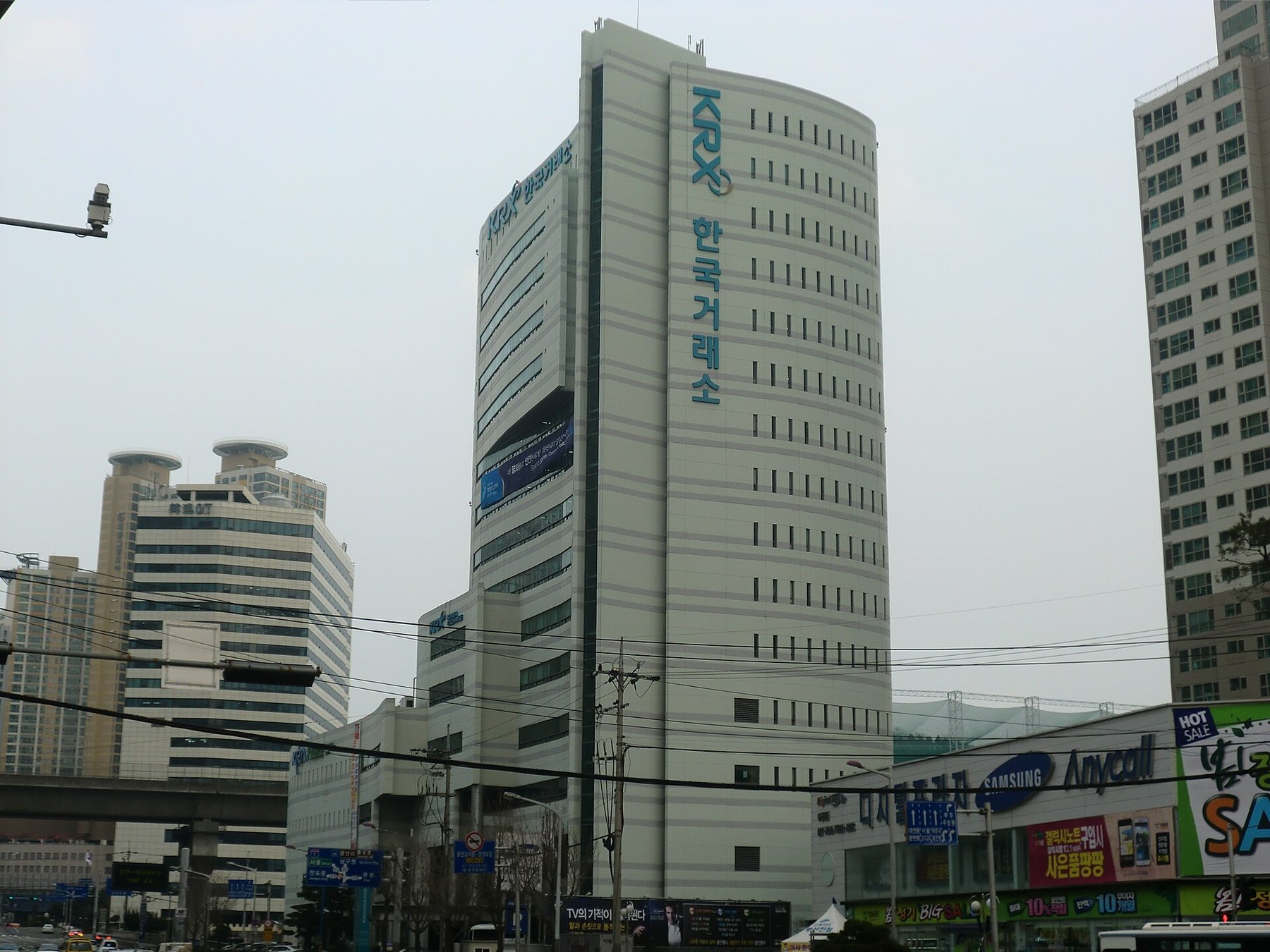
Photo: hyolee2 · Korea exchange.JPG · CC BY-SA 3.0
The KOSPI closed at 4,708.54 on November 23. That is 48.3% below its record closing high of 9,114.55 on June 22. The day before, the government held an emergency market review meeting and said it would prepare the stock market stabilization fund so it "can be deployed right away depending on market conditions." Under the 2020 plan that set it up, the fund invests money committed by financial firms and securities-related institutions in index products such as the KOSPI 200. The committed money is 10.76 trillion won, and the fund has never bought shares. The last time a stock market stabilization fund put money into the market was from November 2008 to March of the following year.
In what situation will this 10.76 trillion won go in, and who will take the losses if there are any?
The government has not yet answered these two questions. At a press briefing on November 23, Deputy Prime Minister and Minister of Finance and Economy Lee Hyoung-il said of the timing of any injection that he "plans to judge while reviewing the situation." On the size, too, he said it is "a matter to review while watching the situation in which it would be deployed." The November 22 press release listed "the activation system, improving effectiveness, etc." as items to prepare. There is no separate law setting the conditions for deployment or the decision procedure.
The Financial Services Commission (FSC) favors limited use when the market as a whole is at risk. At a press meeting on November 13, FSC Chairman Lee Eog-weon said discussion is needed on "whether it must go in whenever there is volatility, or whether it should go in when it reaches the level of a systemic risk in the market." Systemic risk is the risk that a shock in one place spreads to the entire financial market. The judgment not to put money in over stock price swings alone is right. But the FSC has not disclosed specific criteria for what it will look at to judge that risk.
The stabilization fund should not be used to defend a particular index level. The committed amount is 0.27% of the market capitalization of the KOSPI market on November 20. It is less than even the 14.4831 trillion won in net selling by foreigners on the KOSPI from November 1 to 20. If the fund tries to defend the index with this money and fails, the contributions will take losses. In a 2023 report, the Korea Institute of Finance (KIF) analyzed the five stabilization funds in Korea's history. Its conclusion was that the effects "appear to be limited," and that some of the effects may have come from other policies at the time.
This fund should be used when buyers disappear and sell orders cannot be filled. Buying at such a time is different from holding the index at a certain level. It fills the buying side only during the period when orders pile up, so trading can continue. That was how the Bank of England bought government bonds in September 2022. It cited dysfunction in the long-term gilt market, set a deadline of October 14, and stated in its announcement that the Treasury would fully indemnify any losses.
Taiwan wrote the conditions for market intervention into law. The condition is a case where major domestic or foreign events or large movements of international capital seriously shake public confidence. If this threatens to disrupt the order of the financial market or national stability, the National Financial Stabilization Fund can be used by a resolution of its committee. It must report to the Legislative Yuan within three months after the resolution.
To be sure, disclosing criteria in advance carries risks. If the government announces that it will put money in when the index falls by a certain amount, investors may test that line. Some investors may also take on more risk, believing the government will hold up the market. Since the shape of a crisis cannot all be written down in advance, there is also reason to leave the government room for judgment.
Even if numerical thresholds are left to the government's discretion, the principle for sharing losses should be disclosed. The government's 2020 plan included lowering the risk weight on contributions to ease the capital burden on financial firms. It also said tax support to reduce the risk of investment losses would be considered. If tax support is put in place, its cost is borne by the public through lower tax revenue. That is why how far losses go and who bears them should be settled before the money goes in.
The government should disclose four things before putting money in. First, that the purpose of this fund is to restore trading. Second, who decides on deployment and on the basis of which indicators. Third, the loss limits for the contributing institutions and whether tax money will be used. Fourth, the limit and period of the injection, the conditions for ending it, and after-the-fact reporting to the National Assembly.
The first item the government listed on November 22 as something to prepare was the activation system. Once that preparation is finished, its contents should be made public before any money goes in.
Translated from the Korean original published on November 24, 2026.
Korean original: 코스피 절반 가까이 빠지자 증안펀드 준비…손실 누가 지는지 밝혀야