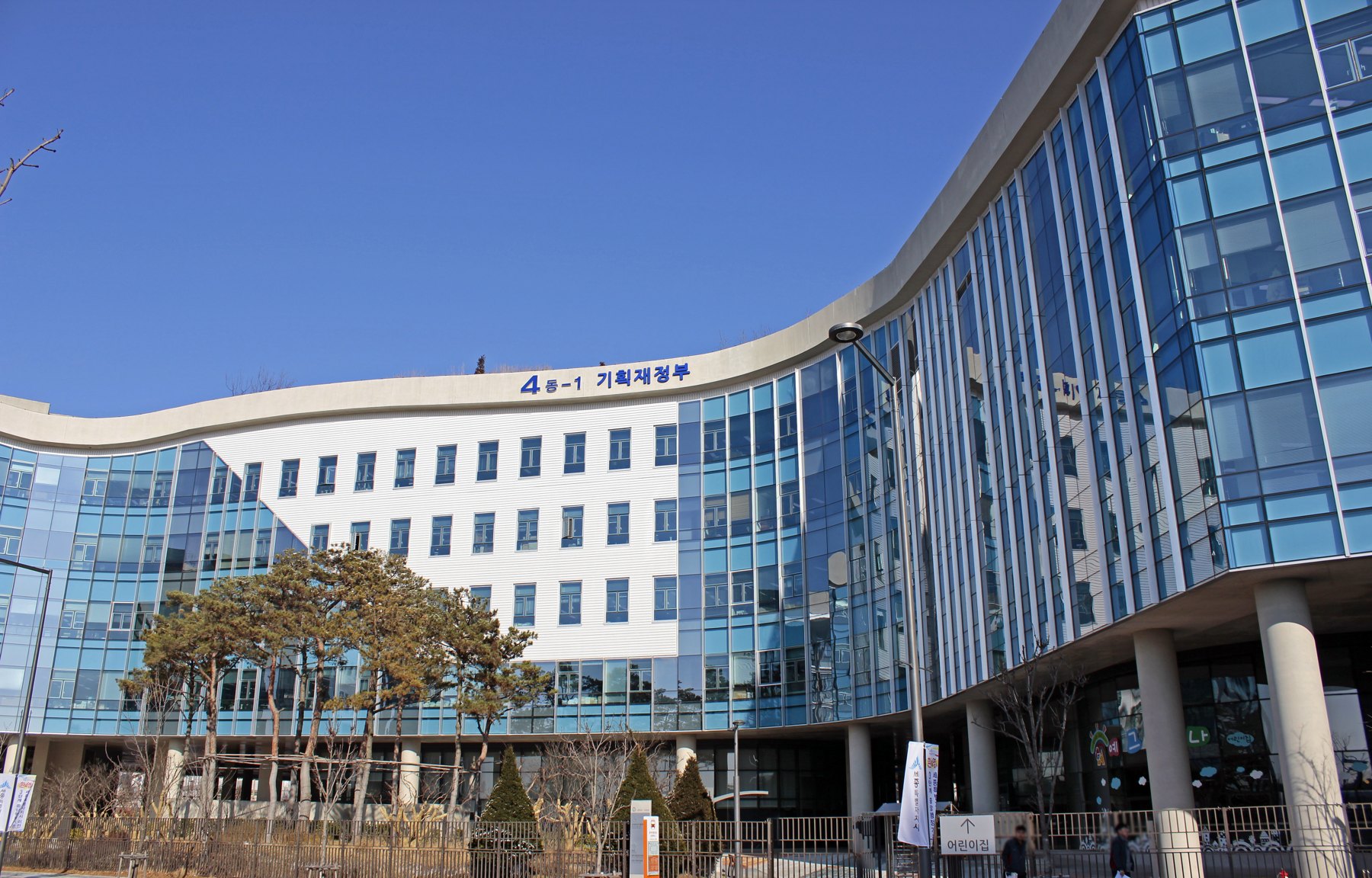
Photo: Minseong Kim · Ministry of Strategy and Finance(South Korea).JPG · CC BY-SA 4.0
Standing committees and members of the Special Committee on Budget and Accounts have so far asked to add 71.9228 trillion won to the government's 820.9 trillion won budget proposal for next year. This is the net increase The Dong-A Ilbo calculated from the National Assembly's budget review materials by subtracting proposed cuts from proposed increases. Standing committees asked for 38.3909 trillion won, and members of the Special Committee on Budget and Accounts asked for another 33.5319 trillion won. Standing committee requests of a little over 25 trillion won for the Future Response Fund are separate from this figure.
The ruling and opposition parties were no different. The Democratic Party of Korea (DP) secretary of the budget committee and others sought a 4.5 trillion won increase for the Southwest semiconductor cluster project. The People Power Party (PPP) secretary of the budget committee and others requested a 332.4 billion won increase for the Daegu-Gyeongbuk integrated new airport. From November 24, the disputed items moved to the sub-subcommittee. It is a closed-door meeting attended only by the budget committee chair, the ruling and opposition party secretaries and a few others, and it keeps no minutes.
It should first be made clear which projects get into the budget, at whose request and why.
Requested amounts are not the budget. Last year, standing committees sent the 2026 budget to the budget committee with total spending raised by up to 29.3126 trillion won. But the final total spending was 126.8 billion won less than the government's proposal. In the 2025 budget, too, final total spending was lower than the government's proposal. It cannot be said that the 72 trillion won will all become national debt.
A smaller total does not mean the National Assembly left the budget as it was. According to the National Assembly Budget Office (NABO), the National Assembly's increases to the 2026 budget, excluding project transfers and similar items, came to 4.1608 trillion won, and 911 projects were increased. Cuts came to 4.2876 trillion won, so the total changed little.
The disputed projects went to the sub-subcommittee without a conclusion in the formal subcommittee. According to The Segye Times, last year the budget committee's subcommittee finished its review of cuts on November 21 and sent about 200 projects it could not agree on to the sub-subcommittee. According to a NABO report, the budget committee did not finish its review by the deadline. The budget bill went to the plenary session automatically on December 1, and an amended bill agreed by the ruling and opposition parties passed on December 2. It was the first time in five years, since the 2021 budget bill, that the constitutional deadline was met.
The problem is that, unlike a subcommittee, the sub-subcommittee leaves no minutes. Under the National Assembly Act, subcommittee meetings are open in principle. Closing them requires a vote by the subcommittee, and the minutes must still be kept in shorthand. But the National Assembly Act has no meeting called a sub-subcommittee. The sub-subcommittee is run as an informal channel where the ruling and opposition parties narrow the disputes in the budget committee's subcommittee.
The money added in the sub-subcommittee is also limited by the National Assembly Act. For the budget committee to raise again the amount of a spending item that a standing committee cut, it must get that standing committee's consent. The budget committee also needs the consent of the relevant standing committee when it creates a new expense category, a detailed line in the budget. But if the standing committee does not answer within 72 hours, it is deemed to have consented. According to a Dong-A Ilbo editorial, this year there were cases where budgets cut in standing committees were revived in the budget committee, such as the Sejong-Anseong and Pohang-Yeongdeok expressway construction projects. If increases that raise the amount of an item a standing committee cut make it into the final bill, the public should be able to know before the vote whether standing committee consent was obtained.
The government also bears responsibility. Under Article 57 of the Constitution, the National Assembly cannot increase the amount of any spending item or create a new expense category without the government's consent. When the government uses this right of consent, it should examine the grounds for each increase. But the fact that the government consented does not by itself tell the public the reason for an increase. The Segye Times named the Second Vice Minister of Economy and Finance as a member of last year's sub-subcommittee, along with the budget committee chair and the ruling and opposition party secretaries. This year's standing committee increases also include 2.0331 trillion won in support for firefighters' personnel costs. On November 8, the government and the ruling party also agreed to consider fiscal support of about 2 trillion won for fire services.
To be sure, the sub-subcommittee has its reasons. According to The Segye Times, the budget committee side explained last year that unless budgets with no agreement were set aside, other budgets could not be reviewed. Making all last-minute negotiations public could make compromise harder.
But holding negotiations behind closed doors is different from leaving no record of the grounds for the results. The National Assembly does not need to open the negotiating room. Once the sub-subcommittee ends, it can make one table by project. The table would list the amount of the increase, the lawmaker or standing committee that first requested it, the reason for the increase, and whether the government consented.
The National Assembly should disclose this table before the plenary vote. NABO compiles the increases and decreases by project in a report after the budget is finalized, based on the amended bill submitted to the plenary session. That report alone makes it hard to know who first requested each project. Lawmakers asking for projects in their districts is not wrong in itself. The legal deadline for passing this year's budget bill is December 2. Before then, the names and reasons behind each project's increase should be made public.
Translated from the Korean original published on November 24, 2026.
Korean original: 국회 증액 요구 72조원…소소위서 다룬 사업은 표결 전에 공개하라