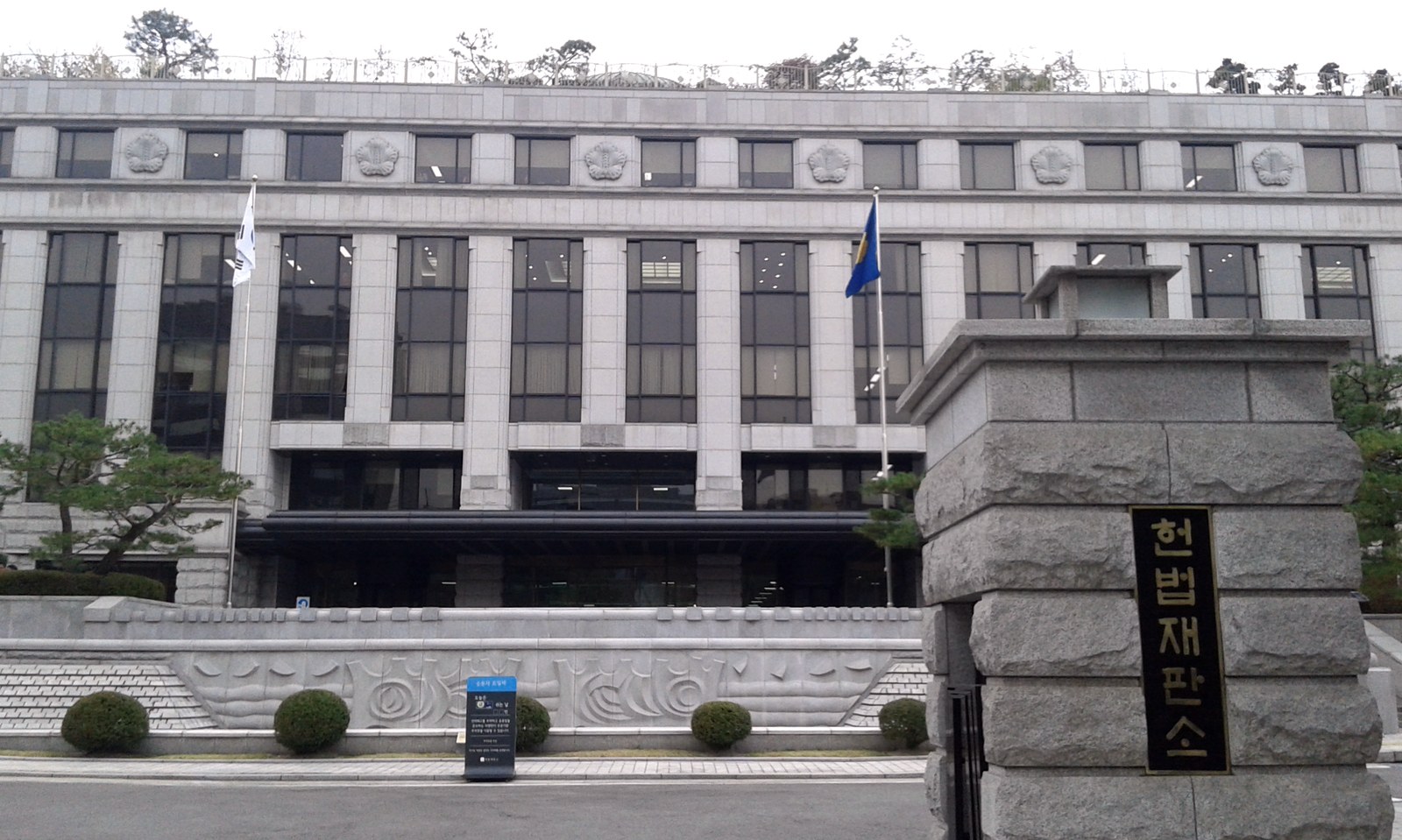
Photo: Pauloleong2002 · File:Court building of Constitutional Court of Korea.jpg · CC BY-SA 4.0
The Democratic Party of Korea (DP) on November 20 made an impeachment motion against Chief Justice Cho Hee-dae its official party line. It came one day after the Supreme Court sent part of the case of former Prime Minister Han Duck-soo back to a lower court with instructions to find him not guilty. The DP said it would introduce the motion within the year. The DP's 161 seats are enough to introduce the motion (100 members) and pass it (150 members) on its own.
Impeachment is a procedure that seeks removal from office. In this impeachment, however, suspension from duty comes before removal.
Article 65, Paragraph 3 of the Constitution suspends the powers of a person against whom an impeachment motion is passed until the impeachment trial is decided. Under the National Assembly Act, this begins when the impeachment resolution is delivered. In the meantime, the most senior Supreme Court justice acts for the chief justice. The Constitutional Court's deadline for a ruling is 180 days from receipt of the case. Chief Justice Jo retires on June 5 next year, when he reaches the mandatory retirement age of 70.
Depending on when the Constitutional Court reaches its decision, this impeachment becomes something entirely different. Comparing the review periods of two earlier cases shows why. The case of Korea Communications Commission Chairperson Lee Jin-sook took 174 days from impeachment to rejection. If the motion passes in early December and the case takes as long, the decision would come before the chief justice's term ends. The case of prosecutor Lee Jeong-seop took 272 days. If it takes as long, his retirement would come first. What happens after retirement? In 2021, when former senior judge Lim Seong-geun retired at the end of his term, the Constitutional Court dismissed the case, saying it could not remove him and so there was no benefit to a trial. If the decision comes after his term ends, the same ruling could follow this time. In that case, the chief justice would leave office with his duties suspended and without a ruling on whether to remove him.
Of course, suspension from duty is a mechanism the Constitution provides. It is meant to keep an official from using his powers until the trial ends. The National Assembly's power to impeach is also a power the Constitution grants. The grounds the DP cited are not only rulings. There is the Supreme Court's response during the December 3 emergency martial law and the dispute over re-nominating Supreme Court justice candidates. There are also allegations over business expenses and cash bonuses. The principle that a short remaining term cannot be a reason to skip asking whether laws were broken is also right. By that principle, the National Assembly only needs to examine which law these acts violated.
The problem is the rulings. The DP included the Supreme Court's reversal and remand of the president's Public Official Election Act case among the grounds. Yang Boo-nam, head of the impeachment task force, said right after the party caucus that the ruling on former Prime Minister Han was not a ground. But after the task force's first meeting, he reversed himself and said it would be reviewed as a ground.
Article 103 of the Constitution provides that judges rule independently according to their conscience and in conformity with the Constitution and the law. Both cases were decided by several Supreme Court justices together. Those who believe a decision was wrong can change the law or contest it in the next trial. Is it acceptable to suspend the chief justice's duties first because a ruling is displeasing? If that is allowed, the same thing could be repeated every time the majority party changes.
Disliking a ruling cannot be a ground for impeachment. If there was an act that broke the law in the course of a ruling, that act should be identified and written down. Taking issue with a conclusion is different from taking issue with an unlawful process.
Kim Min-seok, the DP leader, said at the Supreme Council meeting on November 20 that Chief Justice Jo's violations of the Constitution and the law have piled up. He also said they had "crossed the line of national and historical patience" that had held back an impeachment motion. If so, the motion must state which act violated which provision. The DP must remove the rulings in the president's case and in former Prime Minister Han's case from the grounds for impeachment.
If a motion that includes rulings is dismissed after his term ends, the impeachment could be read not as a procedure seeking removal but as a means to stop him from doing his job. Only by narrowing the grounds to acts can the Constitutional Court decide within his term. That responsibility lies with the side bringing the impeachment.
Translated from the Korean original published on November 21, 2026.
Korean original: 대법원장 탄핵, 판결을 사유로 삼아서는 안 된다