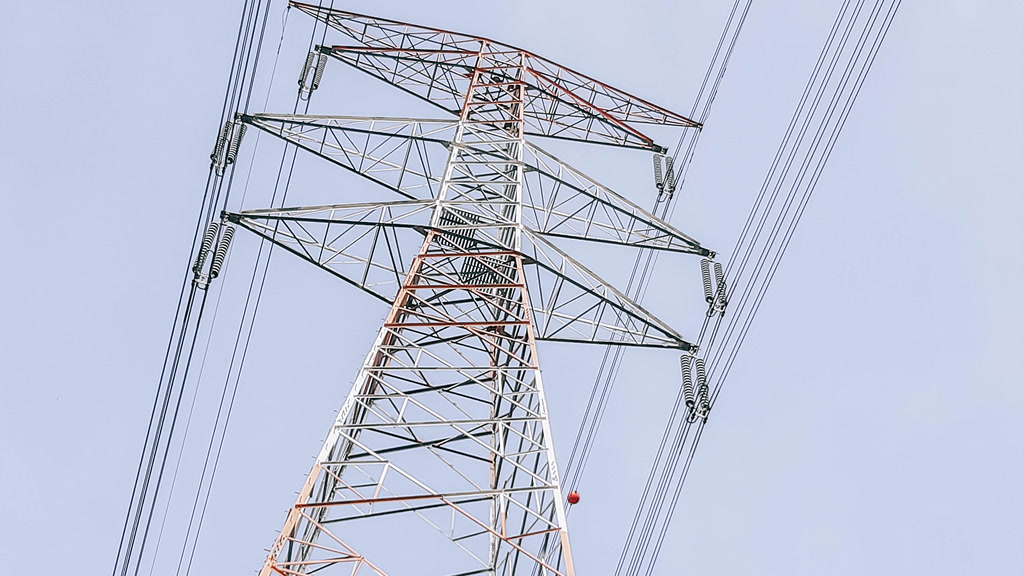
Photo: 뭘로할까 · File:송전탑1.jpg · CC BY-SA 4.0
President Lee Jae-myung visited SK's artificial intelligence (AI) data center site in Ulsan on November 21. Speaking about the construction workforce, he said, "As the world is now competing, speed is everything." SK plans to start here and build 15GW of data centers across five regions by 2035. Power plants and transmission lines are built according to the demand set in the government's Basic Plan for Electricity Supply and Demand. So how much of this 15GW did the government's power demand forecast include?
The 15GW is a figure the government announced together with SK. According to a June 29 press release from the Ministry of Trade, Industry and Resources, the government will build 8.4GW of data centers with SK, GS and Naver in the first phase. SK's share of this is 5GW. The government also wrote that it will pursue a second phase with SK to expand this 5GW to 15GW by 2035. SK is the only company named in the second phase. The 10GW added in the second phase is two-thirds of the 15GW.
In its new forecast in August, the government pushed the second-phase 10GW of data centers to the next basic plan. According to ZDNet Korea, the Ministry of Climate, Energy and Environment and the plan's general committee presented a new 2040 power demand forecast at a public forum on August 20. The data center investment plans submitted by companies came to 20.8GW, measured by contracted power with KEPCO. The government included only 10.8GW of this first. It decided to handle the second-phase 10GW in the next basic plan after watching how the projects progress.
These investment plans came from the June announcement. According to Korea Data Economy News, the 20.8GW is the figure companies presented in the June megaproject announcement. The only project listed as second-phase in the June announcement was SK's 10GW expansion, the same size as the second phase in the August forecast. A presenter at the forum explained, "We postponed including the additional second-phase portion because there was no information on its locations."
Those who postponed it also have grounds. According to SBS, Professor Yoo Seung-hoon said, "Data centers often apply to use 100 units of electricity and actually use only 30 or 50." At the forum, some also pointed out that if investment does not follow, "the public could bear" the burden of the added capacity. Some also said it must be determined whether data centers actually add to Korea's AI competitiveness.
The share included first could also shrink. According to Metro Seoul, Minister of Climate, Energy and Environment Kim Sung-whan said at a parliamentary audit on October 26 that corporate demand is "in a situation where not as much has been concretely confirmed as expected." He added that it is "difficult to put all of the vague demand into the 12th Basic Plan." That day, Lee Jong-bae, a People Power Party (PPP) lawmaker, asked about a report that the government was discussing cutting data center power demand by 3 to 4GW.
Demand left out of the basic plan is also left out of the transmission grid plan. The Long-Term Transmission and Substation Facility Plan, finalized in May 2025, is a follow-up plan drawn up according to the 11th Basic Plan for Electricity Supply and Demand. The 11th plan put data center power demand in 2038 at 6.2GW, based on summer peak load. This uses a different basis from the August investment plans, counted in contracted power, so the two cannot be compared directly. According to Electronic Times, the government draft of the 12th plan was pushed to after December while waiting for the recommendation of the nuclear power public deliberation committee.
Ulsan says it is a region with surplus power, but the power to expand to 1GW is still under negotiation. According to Ulsan Maeil, Ulsan City says it produces more electricity than it uses, giving it a power self-sufficiency rate of 114%. According to Yonhap News Agency, SK Multi Utility can generate electricity with SK Gas's LNG and supply it to the center. Last December, the government designated Ulsan as a distributed energy special zone. This is a system that lets electricity be used close to where it is produced.
But the center now being built is 100MW, one-tenth of 1GW. According to Ulsan Press, expanding to 1GW requires about 900MW of additional power, and talks with KEPCO on this additional power remain. Yonhap cited the procurement cost and carbon emissions of expanding LNG power generation as challenges. The president also said that day that in the long term, "stable and affordable power supply through eco-friendly renewable energy" is a key factor in industrial competitiveness.
Outside Ulsan, fewer places have a stated size. According to Yonhap, SK plans hubs of 1GW or more elsewhere in the Yeongnam region, and 1GW each in the southwestern region and the Chungcheong region. Adding the announced plans to Ulsan gives 4GW or more (NEXT calculation). For the rest, it has not been disclosed how much will be built in which region. In the June announcement, however, the government said it would speed up the power grid impact assessment for centers outside the Seoul metropolitan area.
When will the government put the second-phase 10GW it announced with SK into its power plan? How much of Ulsan's 900MW expansion will SK's own generation and KEPCO's grid each cover? The nuclear deliberation recommendation is due in December, and the Ulsan center aims to begin first operations in the fourth quarter of next year. The president spoke of speed. But the second-phase 10GW the government put forward with SK is not yet in the government's power demand forecast.
Sources
- Yonhap News Agency, President Lee: "Demand for AI data centers and memory will grow further... speed is everything" (comprehensive), November 21, 2026. The president's remarks ("speed is everything," renewable energy power supply) and the written briefing by Cheong Wa Dae deputy spokesperson Ahn Gwi-ryeong.
- Yonhap News Agency, SK takes first step on 15GW AI data center plan in Ulsan... the variables that will decide success, November 21, 2026. 15GW and five regions by 2035, 900MW added to Ulsan's 100MW, Yeongnam, southwestern and Chungcheong hubs, SK Gas LNG and SK Multi Utility generation, KEPCO reserve grid.
- Ministry of Trade, Industry and Resources, "Public Report Meeting on Three Mega Projects for Korea's Great Leap" held (reference and attached report materials), June 29, 2026. First phase 8.4GW (SK 5GW, GS 2.4GW, Naver 1GW), SK second-phase expansion to 15GW, total 18.4GW, disclosure of 345kV substation information, fast-track power grid impact assessment, planned inclusion in the 12th basic plan.
- Ministry of Trade, Industry and Energy, 11th Basic Plan for Electricity Supply and Demand finalized (attached key contents), February 21, 2025. Key contents page 3: 2038 data center power demand of 6.2GW (model demand 1.8GW plus additional demand 4.4GW), based on summer peak load. Page 9: Long-Term Transmission and Substation Facility Plan drawn up as a follow-up plan.
- ZDNet Korea, AI and chip power demand surges... 2040 forecast sharply raised in four months, August 20, 2026. Fifth forum on the 12th basic plan, contracted power of 20.8GW, first-phase 10.8GW, second-phase 10GW to the next basic plan, 2040 data center peak load of 14.2GW, presenter's explanation.
- SBS, Up by as much as 19 nuclear reactors in four months... how was the 27GW calculated (reporter's file), August 29, 2026. Second-phase 10GW not included, remarks by Professor Yoo Seung-hoon.
- Metro Seoul, Kim Sung-whan: "AIDC power demand will be reflected at a realistic level", October 26, 2026. Remarks at the comprehensive audit of the National Assembly Climate, Energy, Environment and Labor Committee.
- Korea Data Economy News, 12th basic plan data center power at 11.9GW, 3 to 4GW cut under review, November 21, 2026. Explanation that the 20.8GW is companies' investment plans from the June megaproject announcement, second-phase 10GW not included, question by lawmaker Lee Jong-bae.
- Ulsan Maeil, Ulsan City steps up bid to attract "1+1GW" AI data centers, July 8, 2026. Power self-sufficiency rate of 114%, 238% after Saeul Units 3 and 4 begin operating (Ulsan City).
- Ulsan Press, Securing power is key to expanding Ulsan AI data center to 1GW, November 9, 2026. About 103MW, additional 900MW and talks with KEPCO.
- Herald Economy, Climate ministry adds North Gyeongsang, Ulsan and South Chungcheong as distributed energy special zones, December 25, 2025.
- Yonhap News Agency, Transmission and substation plan including Yongin semiconductor cluster finalized... 73 trillion won in total (comprehensive), May 27, 2025.
- Electronic Times, 12th basic plan delayed... ruling and opposition parties clash over "three months of nuclear public deliberation", October 6, 2026.
Translated from the Korean original published on November 22, 2026.
Korean original: 데이터센터 전기 어디서?…SK와 발표한 10GW 정부 전력 전망엔 없어