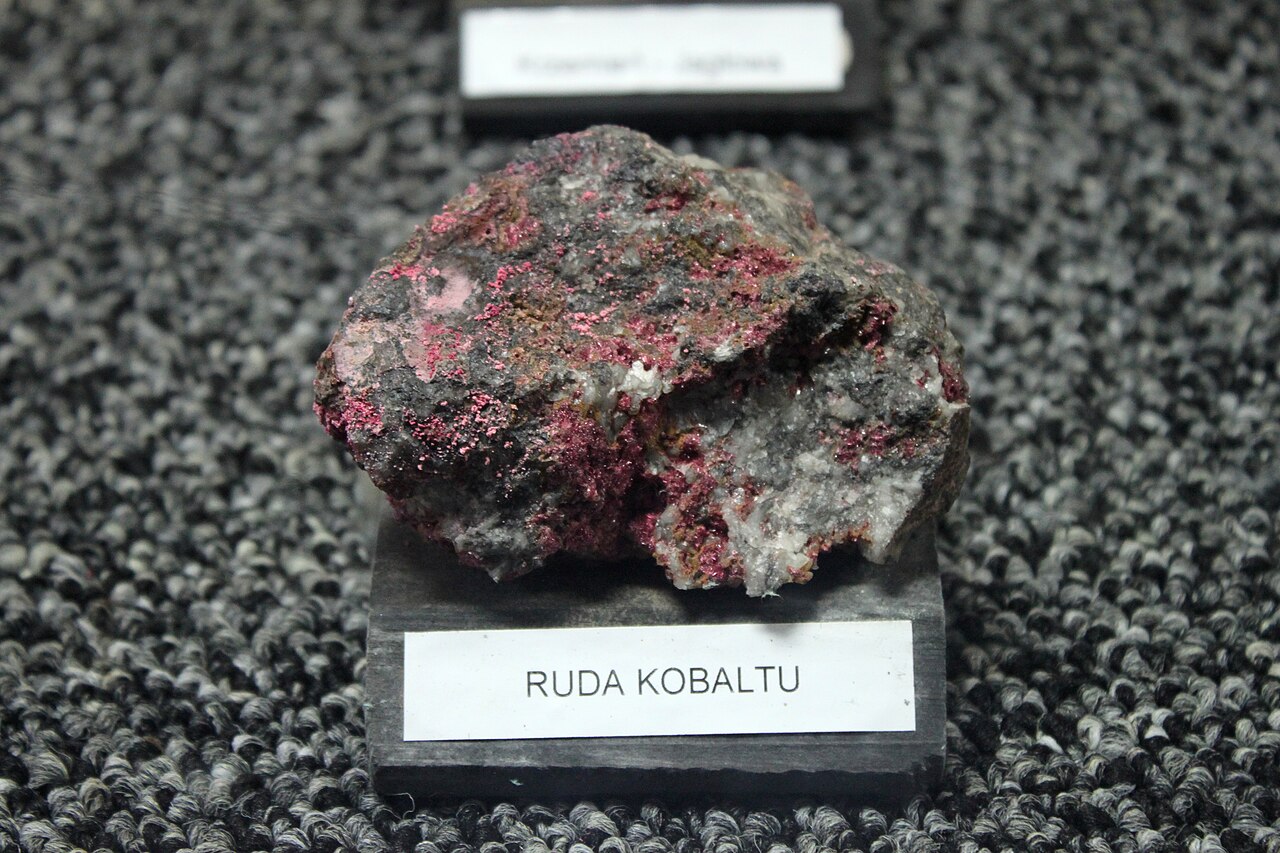
Photo: Crusier · File:Cobalt ore.jpg · CC BY-SA 3.0
The Democratic Republic of the Congo, the world's largest cobalt producer, will stop exporting cobalt again from November 30. The Authority for the Regulation and Control of Strategic Mineral Substances' Markets (ARECOMS), which manages cobalt exports, said on November 23 local time that all cobalt exports will be suspended until further notice. Cobalt is a metal used in the cathodes of batteries for electric vehicles and mobile phones. South Korea's cobalt stockpile was reported in July 2023 at 12 days' worth. How many days' worth is it now?
Before it began restricting exports, the Democratic Republic of the Congo accounted for about three-quarters of the world's mined cobalt. This is its second export halt, after the one in February 2025. That time it blocked exports for eight months, then switched to a quota system that capped export volumes. ARECOMS cited oversupply and weak prices this time. It will review the measure in four months in light of market conditions and inventories.
After the last export halt, cobalt prices rose sharply in China. According to Shanghai Metals Market prices reported by Money Today, the price of electrolytic cobalt, a form of cobalt metal, rose 48.3% between February 24 and March 12, 2025. One analysis said the effect on Chinese electric vehicles was small because of the large share of lithium iron phosphate batteries, which use no cobalt. But Chinese makers of batteries for mobile phones and other consumer electronics began raising prices.
Most of the cobalt raw material South Korea buys also comes from China. According to UN trade statistics, South Korea imported 58.31 million dollars' worth of cobalt oxides and hydroxides in 2025. Of that, 69.7% came from China (NEXT calculation). In 2024, direct imports from the Democratic Republic of the Congo were just over 1% of the total (NEXT calculation). The Congolese export halt could reach South Korea's purchase prices through Chinese market prices. However, these statistics count only one product category and do not cover all battery materials containing cobalt.
The government set a cobalt stockpile target in 2023. In July 2023, The Dong-A Ilbo reported that the cobalt stockpile stood at only 12 days' worth. The Ministry of Trade, Industry and Resources (then the Ministry of Trade, Industry and Energy) responded in an explanatory note that it would secure 180 days' worth by 2029. The note did not separately address the 12-day figure. It also said that because prices swing widely, it would buy in installments with the budget in mind. At the National Assembly audit in October 2026, the ministry said it would raise the upper limit of the critical mineral stockpile period from 180 days to 365 days.
But how many days of cobalt are stockpiled now is not public. KOMIR, which handles the country's mineral stockpile, made the stockpile volumes of 13 minerals, including cobalt, confidential in June 2025. This appears in material that Rep. Park Sang-woong of the People Power Party (PPP) received from the corporation. June 2025 fell within the eight months after February 2025 when the Democratic Republic of the Congo blocked exports.
What Park took issue with was the legal basis for the secrecy. He said that if stockpile information is disclosed, there is "concern that overseas speculative actors or specific countries could strategically exploit it." He also called for a legal mechanism to manage it as confidential. According to EBN, Japan has not disclosed related information since 2021, and China keeps it secret under its state secrets law.
Still, it is possible to say whether the stockpile is growing without revealing tonnage. In March 2026, Rep. Oh Se-hee of the Democratic Party of Korea (DP) analyzed KOMIR data and presented the overall trend. Of the 13 minerals the government said it would stockpile more of, nine had not gained a single day of stockpile coverage, and 10 were below 60 days' worth. The analysis does not show whether cobalt is among them.
The government's latest critical minerals plan focuses on securing supply overseas. At a public-private strategy meeting on November 16, the Ministry of Trade, Industry and Resources placed cobalt, along with tungsten, graphite and others, among seven candidates for priority procurement. The meeting covered a strategy linking mine development to materials production and the resumption of direct overseas investment.
What percentage of the 180-day cobalt goal for 2029 has been reached? During the four months before ARECOMS reviews its measure, how many days' worth of stockpiled cobalt could be released to the market? These questions could be answered with a ratio to the target, without revealing tonnage. As long as the stockpile is not disclosed, the public cannot know how many days of this export halt the stockpiled cobalt could cover.
Sources
- Yonhap News Agency, "World's largest cobalt producer DR Congo halts exports again", November 24, 2026. ARECOMS announcement (citing Reuters and Bloomberg), three-quarters share, eight-month halt in 2025 followed by quotas, review after four months.
- Money Today (via Daum), "Congo bans cobalt exports, Chinese cobalt prices jump 50%", March 14, 2025. Shanghai Metals Market electrolytic cobalt prices, lithium iron phosphate battery share.
- UN Comtrade, South Korea imports of HS 2822 (cobalt oxides and hydroxides), 2025, 2024. China's share is 40,615,014 dollars from China divided by the 58,310,457-dollar total for 2025 (NEXT calculation).
- Ministry of Trade, Industry and Energy explanatory note, "The government will actively expand rare metal stockpiles to respond to supply chain crises", July 25, 2023.
- The Asia Business Daily, "Kim Jung-kwan: 'Make resource security more solid'... 365-day critical mineral stockpile", October 6, 2026. Ministry of Trade, Industry and Resources work report to the National Assembly audit.
- EBN, "Critical mineral information belatedly made confidential", October 13, 2025. Material submitted to Rep. Park Sang-woong.
- The Financial News, "100 days stockpiled, they say, but only 'a few weeks' on the ground", March 19, 2026. Analysis by Rep. Oh Se-hee.
- Korea.kr policy briefing, "Government resumes direct overseas investment in critical minerals... creates resource security fund", November 16, 2026.
Translated from the Korean original published on November 24, 2026.
Korean original: 코발트 반년 치 쌓겠다던 정부…콩고 또 막는데 비축량은 비공개